Category Archives: Anti-Fascism

Richard Spencer Speaking at Auburn University on April 18th, Organized Resistance Forms

Richard Spencer has been trying to make the Alt Right a campus-based movement for a couple of years now.  There are a number of reasons for this, one of which is that they have seen growth from white male Millenials at state colleges in groups like Identity Europa.  Another is simply that state schools have a legal necessity to host people like Spencer, despite his ideology, as long as they can foot the bill.  This is what happened at the disaster of an appearance of Spencer last year at Texas A&M, where the three simultaneous protests were so large that it was akin to a football event.

Now Spencer is planning on speaking at Auburn University in Auburn, Alabama, living up to the promise he made that he would start a “danger zone” campus tour.  He had been raising money last year, but after he was attacked on the street several times, had his non-profit shut down by the IRS, and was roundly politically rejected, it seemed like this was a long-shot.  While this singular appearance is nowhere near what he was hoping to plan in the way of a “nationwide campus tour,” it is still a shocking turn of events. As he announced it, Spencer said, “If this event is anything like my other ones, it is going to be wild. So, I hope to see you there.”

Spencer gave the university $700 for use of James E. Foy Hall for his Tuesday night speech, and the university was forced to give it over to him because of the statutes.  There released a statement that read:

We strongly deplore his views, which run counter to those of this institution. While his event isn’t affiliated with the university, Auburn supports the Constitutional right to free speech. We encourage the campus community to respond to speech they find objectionable with their own views in civil discourse and to do so with respect and inclusion.

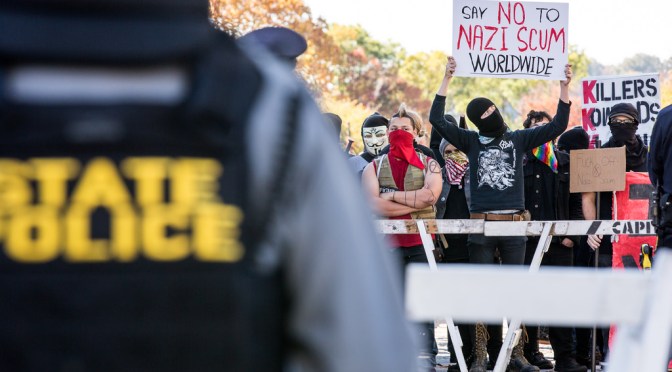
There were two protests immediately announced, including one starting at 6pm and ending at 9pm, coinciding with Spencer’s speech.  The Facebook page for this has since been taken down.  While liberal anti-fascist groups like the Southern Poverty Law Center have said that students should refrain from counter-protesting, large student blocks plan on confronting the event, as well as anti-fascist groups from the region, including Atlanta Antifa.  There will also be an event called “Hashing it Out,” which will address the threat presented by Spencer and the Alt Right during the event, for those who wish not to protest.

This is an important event to oppose publicly because it is the continuation of the only avenue of actual organizing and recruitment the Alt Right really has: college campuses.  This is not just an event for them to share their views, but an opportunity to organize and grow racialist organizations of the area, and for them to exploit the history of Jim Crow in the South.  Expect to see not only Alt Right figures and organizations like Identity Europa, but allso KKK and neo-Nazi groups as well.  Public opposition is the only thing that works, and that is why it will take a groundswell of numbers to cancel the event and set the standard that students will not allow their universities to be used to prop up white nationalism.

On the Question of Nonviolence and Violence As a Tactic and Strategy Within the Social Protest Movement: An Anarchist Perspective

By David Van Deusen (Co-Founder of The Green Mountain Anarchist Collective)


“Let us remember that every great step forward in history has not come into fruition
until it has first been baptized in blood.”
Mikhail Bakunin

NOTE: The essay was first published, not so long after the Battle of Seattle, as a pamphlet by Black Clover Press, Montpelier VT, 2001. It has not previously been available in other formats.


Introduction
Militancy and direct action are not only necessary tactical tools for the anarchist left, but, when correctly implemented, they are also the facilitators of inspiration and motivation for both those involved with the act in question and those who observe the act in question. It is such activity that helps draw numbers into the movement by creating an outlet for the venting of frustration and alienation. In short, militancy and direct action, by challenging the entrenched power of the wealthy ruling class and state, fosters a sense of empowerment upon those who partake, while also furthering creative aspirations by hinting at what a revolution toward a non-oppressive society might feel like.

Of course, militancy and direct action do not carry the inherent qualification of being violent or nonviolent in and of themselves. The slashing of management’s car tires during a labor dispute, as well as erecting of barricades and subsequent rioting against the forces of the State during a pro-working class demonstration are both clearly militant actions, but so too is a non-violent workers’ factory occupation during a strike as well as occupying major city intersections and shutting down of financial districts during a protest against neoliberalism.

Clearly there are many circumstances in which non-violent tactics are not only advisable, but also the only effective course possible. Furthermore, tactical nonviolence is always the preferred course of action when its outcome can bring about the desired objective and subjective results more effectively or as effectively as a violent act. Such practices should be encouraged and taught throughout the anarchist and leftist movement generally in order to maintain a moral superiority over the forces of capital and the state, who of course practices both overt and covert violence with little discrimination on a consistent basis. This commitment to nonviolence is fundamentally based on pragmatism and revolutionary ethics, while finding its material existence through the implementation of tactics. However, nonviolence should, under no circumstances, be understood as a strategy in and of itself. When nonviolence is used as a strategy it transcends its existence as a descriptive term and defines itself as an idea, a noun, as “pacifism”; it becomes an ideology.

When nonviolence is used correctly, as a tactic, it is a most useful tool in the popular struggle. The reason for this is because such a display of resistance is indicative of an underlying threat of violence. For if people are willing to put themselves on the line for the sake of liberty, and if these people are willing to risk bodily harm in such an action, it displays a level of commitment, which, if turned in a violent manner, could manifest itself in the form of a future insurrection; an insurrection where if critical mass is attained could threaten the foundation of state power; that of the ruling class and the underlying anti-culture.

Ironically the victories of the Civil Rights Movement in the South during the 1950’s and ‘60’s owes a lot to the inherent threat of violence. In this case, the southern leadership, embodied in Martin Luther King Jr., expounded upon the need for nonviolence to be utilized as a strategy. However, this movement did not take place in a vacuum. Parallel to the happenings in the South, a movement for black liberation was being launched in the North, and elsewhere, as embodied in the Nation of Islam, later in an autonomous Malcolm X, and then in the Black Panther Party (BPP), and the Student Nonviolent Coordinating Committee, SNCC, a group which formally rejected strategic nonviolence while under the leadership of Stokely Carmichael. This aspect of the movement displayed signs of extreme militancy and was not pacifistic in rhetoric or in character. To the government this represented the logical alternative to which the movement as a whole would turn if certain terms were not ceded to the pacifistic element in the South. The much trumpeted success of the Southern Civil Rights Movement’s pacifistic strategy has, despite itself, much to thank to the threat of violence

In the following essay, I will elaborate on the above theme. First, I will discuss situations where political violence in not only necessary, but ethically justifiable. Second, I will discuss the natural disjunction between strategic nonviolence and the poor and working classes, and finally, I will discuss the contemporary bourgeois roots of pacifism as an ideology of the status quo.


When Violence is Necessary
The fact is that there are times when the only way to effectively advance a movement is through the use of violence. Sometimes, this necessity is clearly in reaction to particular act of state violence, other times it is due to more general circumstances. Either way, justifiable acts of leftist/working class violence are always fundamentally an act of self-defense insofar as the very institutions of the capitalist state inherently constitute continuing physical and psychological violence against the great mass of its people.

“Once the State moves to consolidate its own power, peace has already been broken.”
– Che Guevara

More concretely, violence can be understood as absolutely necessary during certain phases of popular struggle.

This occurs when:

1. Nonviolent options have been explored yet no ostensible victory has been reached.

In the face of exploitation and oppression, inaction is akin to no action, and hence is tacit acceptance and support of those evils. In addition, the continued implementation of proven ineffectual tactics in the face of these evils must be considered akin to inaction, in that ineffectual tactics translates into the same end result; continued exploitation and oppression of the poor and working class by the hands of the ruling class, bourgeoisie and their lackeys. Thus, it would follow that there may arise circumstances, after the exploration of peaceful options, where the only ethical course available to a movement, or individual, is of a violent kind.

2. Whenever State oppression becomes violent, to the point where the movement itself or large segments of the population or the premises on which the people subsist are threatened with liquidation.

The physical self-defense of a people, a movement, or the premises upon which they subsist, is a self-evident right, obvious in the natural world. To claim otherwise is to deny the bravery, justness and dignity of Sitting Bull and the Lakota of the 1870’s, the Jews of Warsaw during the Nazi occupation of the 1940’s, the Cuban’s defense at the Bay of Pigs in the early 1960’s, the man who vanquishes the would-be murderer of his child, and the woman who manages to physically fight off a would-be rapist. To allow for otherwise is nothing but a neurotic self-denying tendency and an unnatural will to suicide.

3. Violence must be understood as a looming fact once the critical mass necessary to seriously challenge a ruling class and state power is domestically reached.

To believe that the state will voluntarily relinquish its power in the face of a moral challenge is as childish and absurd as it is dangerous. History, without exception, has shown that a parent state will react to any legitimate or perceived threat to its domestic power with a ruthless violent suppression of the threat. If that means the murder of large sections of its own population, so be it. Pacifism in the face of such repression translates into no more than the eradication of the insurrectional movement through the means of murder to the sum of absolute death. Once the state finds itself backed into the proverbial corner, it can be expected to act by animalistic instinct; in short, it will fight for its life and will not relinquish until either itself or all of its foes are dead. Let us not forget the 30,000 fallen heroes of the Paris Commune whose blood will forever stain the consciousness of modern France.

Some would argue that the above claim is proven false by the historical fact of Mahatma Gandhi’s pacifistic movement; a movement which did succeed in liberating India from direct British imperial rule. However, such a line of argument does not apply in this case, as that particular case did not occur inside a primary capitalist nation. Rather it occurred on the edges of a crumbling empire. The response of the British government would have differed radically if the movement had occurred inside one of its perceived, primary domestic provinces, or if it were a general domestic movement against the state apparatus itself. The former of which is born out in the fact that the present situation in Northern Ireland has its contemporary roots in the 1960’s nonviolent Catholic Civil Rights Movement.

Therefore, if the goal of the anarchists and the left generally is not self-eradication through a violent counter reaction and the subsequent consolidation of oppressive forces, it will recognize nonviolence for what it is; a tactic, not a strategy.


Pacifism as Foreign to the Poor and Working Classes
One must also question the ability of a nonviolent movement to generate the critical mass necessary to substantially challenge the entrenched fundamental power structure of the nation/state. Since the death of Martin Luther King Jr. in 1968, pacifism has failed to attract any significant numbers outside of the upper middle and wealthy classes. The reason for such failure is that pacifism does not commonly attract members of the working and sub-working class because it bears no resemblance to their experience of reality or their values and shared history of struggle.

If one’s goal is to aid in the building of a serious revolutionary movement, one must be sure that movement is inclusive to those classes that inherently possess revolutionary potential. Thus, it is necessary to construct a movement which is empirically relevant to poor and working class reality. This not only means agitation on their behalf, but also utilizing a strategy which is consistent with the developing/potential class consciousness of such a constituency. If a movement fails to do such, it will fail to draw the necessary critical mass from those classes and in turn will fail to achieve its supposed goals. Furthermore, such failures are probably indicative of the co-option of that movement by ideological prejudices imported from the bourgeoisie; most likely in the form of upper-middle class activists present in the left. Nonviolence, as a strategy is a perfect example of such counterproductive prejudices.

I have often heard discussions among upper-middle class activists about the need to stay away from violent confrontations with the state at demonstrations in order to “not turn people off”. The fact is the only people who are likely to be automatically turned off by legitimate acts of self-defense are upper middle class and wealthy types who will most likely never be won over to the side of revolution anyway. On the other hand, it is common that folk from within the poor and working classes are inspired by the direct and unobstructed confrontations with the forces of the status quo. These communities appreciate the honesty, dignity, and bravery that popular self-defense demands. These are the future agents of revolution and they are not as easily turned away by the truth that real struggle entails. Violent self-defense on behalf of, and through a constituency emanating from their class, is a more pure expression of their collective frustrations brought on from alienation and made objective through their continuing poverty or sense of slavery through accumulated debt.

To further illustrate this all one has to do is look at the various strikes, demonstrations, protests, riots, etc., of the past two years to see how those from within the poor and working classes have conducted themselves when confronted with state violence and restraint. Here we can observe the violent uprising of the poor and working class black folk within Cincinnati (April 2001), the anti-capitalist riots of the Quebecois youth A20 (anti-FTAA demo, Quebec City, April 2001), the numerous Black Bloc anti-capitalist actions throughout North America and Europe (Seattle, 1999, through Genoa, 2001) the armed peasant uprisings from Bolivia to Nepal, the massive militant protests of the Argentine working class against the neoliberal policies of the capitalist government (summer, 2001), the violent union strikes within South Korea, as well as countless other examples of poor and working class resistance the world over.

Compare these developing mass movements composed of persons squarely within the more oppressed economic classes to the relatively impotent and groundless protests of strictly nonviolent upper middle class “reformers”. Two decades of liberal dominance within the left, from the late 1970’s through the later 1990’s, resulted in little or no tangible victories, and often resulted in isolating left wing politics from its supposed mass working class base. These liberals, democratic socialists, non-government organizations (NGO’s), etc., failed to deliver a mass movement of an oppressed constituency. All they did manage to deliver was countless boring protests, which rarely even received media coverage of any kind, and Walter Mondale, as the losing alternative to Ronald Reagan in the 1984 U.S. Presidential election.

The basic fact is, the strategy of nonviolence is foreign to the poor and working classes, and any grouping which places such an ideology ahead of the real desires and inclinations of the masses of exploited people will inevitably remain marginalized, isolated, and ineffectual. Here they become no more than the would-be mediators of continuing alienation and oppression, if only with a dash more of welfare programs and workplace safety boards.

Pacifism is foreign to the social reality of the workers. For example, few of us who grew up without the privilege of gross excess capital did so without learning the value of knowing how to fight. Unequivocal nonviolence in grade school would have earned us the same thing it does in the political arena; further bullying, further oppression. An early lesson for many of us was the effectiveness of “standing up to the bully.” Such an act always carried with it the threat of violence, if not the implementation of violence. To take such a stand without such a commitment would have resulted in nothing more than a black eye. It is from this early age that the more oppressed classes learn the value of violence as a tool of liberation.

Historically, violence has proven to be politically relevant through union struggles and neighborhood fights against the exploitation of the poor and working class. The history of the labor struggle is a history of blood, death, and dignity. From the Pinkertons to the scabs, to the police, army, and National Guard; from lynching to fire bombings the U.S. Government, acting as the political ram of the ruling class, more often than not has forced the working class to defend itself through its only proven weapons; class-conscious organization and self-defense, when need be, through violence. This is a historical fact that is apparent in the social underpinnings of working class community, if not always consciously remembered by its inheritors.

In addition, the more advanced elements of the poor and working class has, for 150 years, been exposed to and has autonomously developed ideologies of liberations which not only map the current state of affairs and predict future trends, but also prescribe the justified use of violence as a necessary element of their own liberation. In turn, these ideologies, although often greatly flawed, have been a consistent traveler through the trials and tribulations of these workers since the dawn of the industrial age. When successes were found, these ideologies were also present. Although it is true that much leftist ideology is becoming a dinosaur of the past within primary capitalist nations (i.e. those espousing the various forms of authoritarian communism) it must be recognized that in and of itself it has been responsible for its own transcendence. It is part of the common history of struggle and even with its passing it reserves a place of prestige within the social unconscious of the past and present revolutionary struggle. You tell me how willing the more self-conscious elements of the poor and working classes are to deny this history.

Of course, violence should not be canonized. These same communities implement violence upon themselves in a destructive manner as well. Domestic violence, murder, and armed robbery of members of their own class is a reality in many poor and working class neighborhoods. But, these forms of internal violence can be attributed to alienation as experienced in an oppressive society. Thus, crime rates have historically plummeted in such neighborhoods during times of class autonomy (i.e. Paris 1871, Petrograd 1917-1921, Barcelona 1936-39). Of course, we should condemn such negative forms of violence and work toward their eradication, but we should do so without throwing the baby out with the bath water.

Violence, both of a positive and negative sort, is an element of poor and working class culture. Violence is also a proven tool of liberation in poor and working class ghettos, both in relation to the personal and the political. And finally this reality is further validated by ongoing world events and historical fact.

Nonviolence as a philosophic universal must be understood as the negation of the existence of the poor and working classes. And no, I do not solely mean their existence as an oppressed element; I mean their existence as a class which possesses a self-defined dignity through their ongoing struggle against alienation and exploitation.

Ideological nonviolence is the negation of their shared history of struggle. It denies their dreams of freedom by its sheer absurdity and stifles certain forms of their self-expression through its totalitarian and insanely idealistic demands. In a word, strategic nonviolence is the negation of class consciousness; it is irrelevant at best and slavery at worst. In itself, it represents the conscious and/or unconscious attempt of the more privileged classes to sterilize the revolutionary threat forever posed by a confident, self-conscious, and truly revolutionary working class.

Once again, it is conceivable that some would argue the contrary by pointing to poor and working class involvement in the nonviolent movement in Gandhi’s India and/or Martin Luther King Jr.’s Civil Rights Movement. However, the extent to which non-violence was accepted as a strategy by these classes is born out in the events which followed the initial successes of these respective movements. In India the same elements that partook in nonviolent actions quickly, and regrettably, fractioned off into two camps; the Hindu on the one hand and the Muslim on the other. Not long after, these factions had no qualms about mobilizing to fight successive wars against one another. Let us remember that both these factions today possess nuclear weapons, which are aimed at one another. In the southern U.S. many of the same persons who marched with King also adopted a decidedly non-pacifistic strategy in the later days of SNCC, the formation of BPP chapters, and the Black Liberation Army cells throughout the region. In addition, let us not forget the riots which occurred upon the news of King’s assassination, turning the black ghettos across the U.S. into a virtual war zone. In the final analysis, both of these pacifistic movements must be recognized as only being such in the minds of their respected leadership. The masses of poor and working class people, which gave these movements their strength, never internalized nonviolence as a strategy; rather nonviolence was no more than a particular tactic to be used as long as its utility bore itself out.


Psychological Roots of Pacifism as a Bourgeois Ideology
So, if pacifism bears no resemblance to poor and working class reality and has no historical or sound philosophical base, what can its existence, as a strategy, be attributed to? The answer is: the deformed ideology of the progressive element of the bourgeoisie and petty bourgeoisie – in other words that of the classes composing the higher and lower levels of the wealthy privileged classes.

It is true that many individuals from these classes have become legitimate and outstanding revolutionaries through the process of becoming radicalized and declassed; Mikhail Bakunin, Karl Marx and Che Guevara to name but a few. And of course, there are many such individuals in our movement today. But, it is also true that many bourgeois elements present in the left still cling to their class privileges and prejudices as if a gilded crutch. They are oddballs in that they are bourgeois yet are driven by a self-loathing as facilitated by class guilt. On the one hand they wish to rectify the ills they feel responsible for, and on the other they are too unimaginative and weak of constitution to cleave themselves from their class privileges and the relative security that entails. Hence, they cling to the only political strategy which can, in their minds, both absolve them from their materials sins and maintain the status quo of their class security; in a word, they become pacifists. In this move they reject the dialectical materialism of both anarchism and communism by subjecting themselves to an idea at the expense of concrete experience.

Pacifism lacks any sound material bases. A quick observation of nature will tell you that the natural world is not without violence and human beings are not outside the natural world. Life is violent. Everything from the eruption of a volcano, to the lion’s killing of her prey, to human ingestion of a vegan meal, possesses a degree of violence. Think of all the weeds that were killed in the production of that tomato, or of all the living microorganisms that our body necessarily destroys through ingestion, or through the very act of breathing; that is violence.

Like the eighteenth century French philosopher Rene Descartes, these charlatans reject the fact of the body for the phantom of the mind. They create the idea of unconditional nonviolence and enslave themselves to it; instinct, lived experience, historical fact, be damned. Through their ideology they become the same beasts of dualism that have tethered the human race from Plato to Catholicism.

Pacifism is fundamentally at odds with anarchism in its view of the state. Pacifism functions by the maxim that the tacit and active perpetrators of oppression (i.e. the state through the ruling class) possess an inherent ability to rectify themselves if the true appalling nature of that oppression is unmasked to them. Hence, it is also assumed that the ruling class possesses the ability to make such an observation and that it will display the desire to make such change. Anarchism contends that the very existence of a state apparatus insures the continuing oppression of the exploited classes. This is due to the inherent tendency of power to corrupt those who possess it; and those who possess power seek to consolidate that power. The state apparatus tends to safeguard itself from such possibilities through the creation of bureaucratic institutions which entail a codified dogma specifically designed to maintain the status quo. With this development class oppression becomes an irreversible fact, within the statist paradigm, even in the unthinkable unlikelihood that large elements of the ruling class were to desire its radical reforming. In this sense the state is a self-propelling evil that is no more capable of eradicating class oppression than it is of eradicating itself; Frankenstein’s monster resurrected. Therefore, pacifism is fundamentally at odds with anarchism. Either the state is potentially a vehicle for liberation, or it is an institution of slavery. Plain and simple.

Bourgeois pacifists become modern ideologues of a confused status quo. They adhere to pseudo-rebellion, and in doing so they serve the function of bolstering the state through the implementation of a strategy that acts as an abstracted semblance of insurrection; a false, non-threatening insurrection squarely within the parameters of the predominant anti-culture. And here they defuse the revolutionary potential of any movement they touch by acting as the unconscious arm of the expanding anti-culture apparatus of false appearances and mundane stability. For as long as their strategy lacks any real potential to fundamentally challenge class bias and status quo; as long as such a strategy is devoid of the true ability to deconstruct the economic and cultural system that allows for the establishment of the bourgeoisie and petty bourgeoisie; as long as this strategy takes on a language of righteous and pious revolution, these self-loathing activities of a physical comfort can go to sleep at night both feeling redeemed through their rebellion and secure in knowing their tacitly oppressive luxury will be there for them again, tomorrow.

What further makes these pacifists oddballs, is the fact that through their pseudo-revolutionary activity they incur an alienated relationship with the less analytical elements of their own class, who in their ignorance constitute the class majority. These elements mistakenly view them as class traitors. This is ironic because nothing could be further from the truth. These people stand fundamentally in solidarity with their roots. And, if their activity has any ostensible effect on the larger movement, it is to prolong the day of insurrection, not to expedite it.

If left to their own delusions they would not deserve such discussion, but they, like Christian missionaries, seek to spread their neurotic illusion to new populations; in this case the poor and working classes. And in doing so they have infiltrated the leftists and anarchist movements and even now threaten to rob it of its pressing relevance by divorcing it from its learned experience.

The poor and working classes are naturally not drawn to pacifism. If pacifism becomes the prime mode of operation for leftists and anarchists organizations, these organizations will cease to have any legitimate tie to their natural constituents. Although it would be ignorant to contend that such an ideology will fail to gain a certain degree of reluctant converts among naturally opposing classes. If such irrationalities never occurred in society, Italian and German fascism would never have manifested themselves with the power that they did. In short, aspects of the poor and working classes can be expected to adopt a self-denying ideology if that ideology claims to offer liberation and if that movement in which it is contained appears to be the most prominent in the field. This is not to say that the true movement will be abolished through such a scenario, any more so than it denies the ultimate historical relevance of dialectical materialism, it is only to say that it will prolong the day of reckoning by robbing the oppressed classes of their truly revolutionary organizations.


Conclusion
Perhaps the best way to have repelled Franco’s fascist invasion of Spain in 1936 would have been for the C.N.T. and F.A.I. to hold a peaceful sit-in? Maybe Adolph Hitler would have reversed his genocidal policies and instead made strides towards a free society if enough Jews and gentiles would have peacefully marched in Berlin. If non-violence was the strategy of the Devil, he’d probably be ruling heaven right now… no.

In the end analysis, just as there is a place for tactical nonviolence, there is also a place for violence during certain phases of a popular movement. This can manifest as a tool of self-defense or as the midwife of state disembodiment. On the other hand, pacifism, as an ethical system of action, is nothing but an absurd dilution born out of resentment and fear and projected upon the struggles of the poor and working classes by oddball elements of the bourgeoisie. As long as such a strategy is allowed to occupy a prominent role among the ranks of the left, the left will equal the total sum of the socially inept ruling class.

In summation, nonviolence can be used in many circumstances as an effective tactic, but it is irrelevant, irresponsible, and utterly ridiculous to even consider it as a strategy. So yes, nonviolence should be utilized as a tactic where pertinent, and in turn pacifism, as an ideology and a strategy, must be purged from our movement.

The author’s opinions here are their own, as with all articles on the site.

Richard Spencer Calls for a “White Bloc” to “Defend Against” Anti-Fascists

Richard Spencer has been having a tough couple weeks.  Donald Trump’s decision to intervene on the Syrian conflict, blanket bombing airfields, runs in direct contradiction to the Alt Right’s isolationist nationalist politics and desire for Trump to find an ally in Assad.  Spencer, along with Alt Right outlets like VDare, the Daily Stormer, Counter Currents, The Right Stuff, and others, have spoken out loudly against this, attempting to co-opt the language of the anti-war movement.

In doing this, Spencer arranged an Alt Right protest in front of the White House on April 9th, bringing together the young hosts of the Alt Right Politics podcast from Spencer’s own Radix Journal and Mike Peinovich (Mike Enoch) from The Daily Shoah and The Right Stuff.  They were met by a massive anti-fascist contingent, including organizers from D.C. area groups and the One People’s Project, who clashed with their attempt to carve out a space for themselves.  While the radical left is uniformly against the U.S.’s imperialist intervention, Spencer’s crowd is one who uses this as a proxy for white nationalist talking points, and this superficial agreement is no cause for shelter.

As happens to Spencer regularly, the confrontation became so heated that Spencer was forced to run away, covered by a bodyguard he brought.  He got into a cab that was blocked and had to run down the street as protesters swarmed around him, and two protesters ended up arrested.

Later, on reflection, Spencer spoke about the intensity of the conflict between anti-fascists and the Alt Right, including him most specifically.  Not only has the anti-fascist movement intensified, the average American has sided with anti-fascists against Spencer, and he can no longer enter public places without the possibility of conflict.

“That was the first time some type of use of force was used,” said Spencer about being “glitterbombed” during the event.  “You don’t know what anyone’s throwing at you when it’s glitter.”

Spencer and his crew went on to recount the story, signaling themselves as victims even though they were on camera antagonizing the crowd, calling people “faggots” and “pussies,” and making racist and anti-Semitic comments.

“Basically what’s happening is everything is escalating,” says Spencer, about the increased opposition he is facing.

If we’re going to do a demonstration then we’re going to have to escalate protection.  And I’m not going to talk about what we’re doing, but we are doing something…They’ve already escalated and I don’t know what degree they’re going to actually change [anti-fascist protesters].  They are just going to become more intense.  We know what Antifa basically do.  And this is where we are, and we need to escalate in terms of protection and we will.

The co-host later asks if Richard would like to “extend a little call to arms.”  Richard agrees to.

I will extend a call to arms in this sense, I’ve said it before and I’ll say it again: we need to form right-wing safety squads.  We need to form a “white bloc” that will counter the black bloc.


Watch Richard Spencer Run from Antifa [VIDEO]

On April 9th, Richard Spencer, with the support of Mike Peinovich (Mike Enoch) and several other Alt Right “shitlords” held a rally in front of the White House in opposition to Donald Trump’s bombing of Syrian airfields. This strays from their American First nationalism, as they quite like Assad’s authoritarian regime in the Middle East. While the left also opposed the invasion of Syria, it is for dramatically different reasons than the Alt Right, organized anti-fascists came out to confront the Alt Right at their rally. What ensued was Richard Spencer and other far-right provocateurs baiting, insulting, and prodding the opposition.

The anti-fascist contingent swelled so large that the Alt Right were forced to cut down their rally early and were chased out of the square. Richard then tried to get into his planned ride, but anti-fascists blocked this. Spencer then got into a cab, which was also blocked by anti-fascists, while police came to Spencer’s defense. Spencer cowered and then ran out of the cab and down the street as police tried to block the anti-fascist protesters. Police arrested two anti-fascist protesters, and we will be posting information on how to donate to their legal fund when that information becomes available. The video ends by following Spencer as he ducked in and our of alley ways, hiding from protesters, and then mocking them when he felt like he was safe. This really shows that his ability to organize has been destroyed by the opposition, and he will never be able to hold an unopposed public event.

The video below is the best video of the whole incident, including Spencer being run out of town and the protesters being arrested. We do not enjoy sharing a video below that includes Spencer being able to speak his views, nor do we endorse the operation that put the video together, but it is also the most clear angle of the events we have found thus far.

The World Without Forms

By Rhyd Wildermuth

I said to a friend, we see the darkness, and some go in.

It is the Abyss.
We have to find out what is there, to find out if there is meaning. And we see only the abyss. And some go mad. And some never return. And some—
And some, I said, come back wielding light against that darkness. Seeing nothing, we bring back fire, we light lamps, candles, torches. We hold light that isn’t ours, as how else would any else see?

***

Terror often greets the far-off glances on the faces of those who return from the Abyss. The lone wanderers who walked boldly into the darkness past the boundary of fire- or street-light, the mad poet, the uncouth heretic, the unshowered witch: their reckless journeys are not celebrated when they return.

Like the ones who ‘walk away from Omelas,’ they did not know to where they were going, only somewhere not-here, not the streets full of opulent wealth and the joyous cries of liberation made possible by a founding horror. But unlike in Le Guin’s story, the city is the world, and there is nowhere else to go except back to those same streets, their eyes no longer glinting with the shallow laughter of civilization but nevertheless lit with fire.

It is their own fire, and it is a fire others are right to fear. It is a fire that can reforge the world.


am what some might call an Egoist. I can also be described as a Nihilist, a mystic, an esotericist, a witch, a Pagan, an Anarchist, and also a Marxist. None of these labels actually mean anything–they are only useful when attempting to speak as the locals speak, to use the prescribed language of Capitol/Capital, treating ‘words that stay’’ with the same fetishism which Marx ascribes to commodity-cum-currency.

It is generally easier to list what I reject (for those of you checking-off boxes on mental clipboards) than it is to begin the litany of what I embrace. Few have the time: there are stories that must be told for each thing before they can be understood, and such narration seems mere obfuscation to those for whom reductionism and essentialism (as endemic to the American ‘left’ as it is to the ‘right’) are unconscious requirements to get at the ‘truth.’

I will tell you what I do not like. I do not like racism or racialism; I do not like gender or genderism. I do not like property or propriety, nor do I Iike borders and what they define. Also, Capitalism and Liberal Democracy and Empire are my least favorite things in the world, along with their shadow, Fascism.

Here, though, I should remind you: “Fascism” means nothing at all. It is a word invoked by people overcome with a strong urge to shore up the ruins of Empire by recourse to even more tenuous concepts with even less material basis: Tradition, Race, Gender, Morals, the Nation. Though the words are mere sounds we make with our throats or symbols printed with ink or displayed on screens, they each serve to outline vaguely (and by their vagueness gain more power) ideas which nevertheless have great power in the realm of the human social.

Max Stirner called these ideas ‘spooks.’ Others would call these ‘constructs.’ I prefer to name them spectres or Egregores. They are also the mythic, and it’s the realm of the mythic I understand best, which is also the realm the Fascists are trying to take from us.

Spooks That Kill

Carl Jung gave a speech in 1936 in which he suggested a “Wotanic spirit” had begun to inhabit the National Socialists, as if the people had become possessed by a god:

Perhaps we may sum up this general phenomenon as Ergriffenheit — a state of being seized or possessed. The term postulates not only an Ergriffener (one who is seized) but, also, an Ergreifer (one who seizes). Wotan is an Ergreifer of men, and, unless one wishes to deify Hitler– which has indeed actually happened — he is really the only explanation.

Jung invokes his theory of gods as pre- and un-conscious archetypal drives to defend his thesis, but like much of the rest of Jung’s work, it’s always unclear whether he believed there was not really a god there. But Jung does not quite mean what we generally think of as a god. Wotan is a “buried drive” within the Germanic people, one which essentially haunts the ‘race’ until it becomes manifest.

“Because the behaviour of a race takes on its specific character from its underlying images, we can speak of an archetype “Wotan.” As an autonomous psychic factor, Wotan produces effects in the collective life of a people and thereby reveals his own nature….It is only from time to time that individuals fall under the irresistible influence of this unconscious factor.”

Jung’s racial essentialism here is tragic and prefigures the biological and genetic essentialism which now dominates Western thought. However, the concept of a mass possession by an unconscious form fits incredibly well with what we know of Nationalism.

Consider the World Trade Center attacks in 2001 in the United States. After the attacks, people experienced (and were diagnosed with) trauma from watching the explosions on television, so much so that some (including otherwise sane and clear-thinking friends of mine) for a little while believed they had either actually been present at the event or had a close friend or family member within the destroyed towers. Worse, many otherwise virulently anti-war people suddenly regained national ‘pride,’ literally waving flags with such civic devotion that one would have thought their life depended upon it.

Devotion to the Nation after such traumatic events often takes on both a religious quality (similar to that of evangelical Christians) while displaying symptoms of mass hysteria. The Nation appears to haunt the actions of the individuals, manifesting and reifying itself as if by possession or seizing.

What Jung noticed regarding the possession of the German people by “Wotan” is this same process. And while one need not believe it was Wotan who possessed his people (I do not—I’ve asked him myself), Jung’s assertion that a mythic force can operate on the psyche is hardly a unique idea. The same function was described by Max Stirner as ‘spooks,’ ideological and philosophical forms which exert influence when they are unconsciously accepted as really-existing.

Spook, Spectre, Egregore

Jung’s theory of archetypes—as well as Stirner’s theory on Spooks, may have been influenced by an occult theory regarding near-deific spirits known as egregores. An egregore (greek for ‘watcher’) is a spirit composed of the memories, knowledge, personality, and intentions of a group, which either arises organically from the activities and interactions of the group or is constructed willfully by the group.

Egregores could be called ‘group minds,’ though they exist autonomously (like Jung’s archetypal Wotan) and maintain the cohesion, survival, and collective identity of a group beyond the individual goals of each member. Unlike an archetype, an egregore does not spring from the unconscious/pre-conscious mind, but rather the myriad actions and interactions of those within in. Unlike a god, an egregore is not something one worships or necessarily invokes. They can be constructed, but after their construction the apparent life they take on is much more complex than what they were constructed to be.

A more accurate explanation may be to say that they are real-ised; brought from the realm of infinite possibility, the world without forms, into the more finite realm of social existence. Yet another theory is that they become inhabited after-the-fact by pre-existing spirits, similar to the way many animistic cultures build shrines as houses that benevolent spirits (or fairies, etc.) will want to move into.

Like Jung’s ‘Wotan’ and Stirner’s Spook (and to some degree Derrida’s ‘Spectre’), the Egregore describes the apparent realness of a thing despite its disconnection from the material world. There is no ‘there’ there, and yet it functions always as if there was, manifesting itself in the actions of those who live within its realm of influence or meaning. And it thus acts also as if it were a god, making demands upon its followers who constantly (and often unconsciously) manifest its existence.

This same process has been described by other means by post-colonialist theorists. Dipesh Chakrabarty, particularly, proposes in his introduction to Provincializing Europe that it is precisely European exceptionalism that prevents us from seeing how those of us in Liberal Democratic societies still “inhabit these forms even as we classify ourselves as modern or secular.” Similarly, Frantz Fanon and James Baldwin speak to the way that belief in whiteness and its psychological manifestations seem to inhabit those who, in Baldwin’s words, “believe they are white.”

One need not necessarily accept a supernatural explanation for the way the mythic manifests as-if it is real in order to comprehend this idea. Benedict Anderson’s formulation of the Nation as an ‘imagined community’ also points to the same mythic and Egregoric functioning. For him, the Nation is a modern constructed form creating an indefensible (yet fully-manifest) sense of (false) horizontal kinship with complete strangers, as Anderson says, making “it possible, over the past two centuries, for so many millions of people not so much to kill as willing die for such limited imaginings.”

America exists; yet we cannot point merely to the constitution of the United States, nor to its government and institutions, soldiers and politicians and police, and say: this is America. America exists within the psyche of Americans, constantly reproduced through self-description and unconscious acceptance of its goals, desires, and inevitability. America is an egregore, a god-form, inhabiting the psyche of its individual constituents, like Jung’s Wotan: “…an autonomous psychic factor, …produc[ing] effects in the collective life of a people…”

The Fascists Know What We Prefer To Forget

Race, Gender, and all other ‘identity’ categories function this same way. Gays imagine themselves part of a ‘gay community,’ yet there is no such thing, only an imagined kinship with people who just happen to like sex with people who have the same genitals as themselves. A horrific attack on people who call themselves gay (such as the Pulse massacre in Orlando) thus manifests in individual gays elsewhere (as was the case for myself and many of my gay friends) as an attack on us as well.

We see this egregoric manifestation even stronger in whiteness. Whiteness has no material basis, yet it does not need one to manifest through the social interactions of humans. Whiteness ‘possesses’ the white person, and appears to inhabit their interactions with people possessed by other egregoric racial categories (Black, etc.) regardless of their oppositional nature. In fact, the conflict and tension between egregores only further refines and entrenches their influence and power.

Neither the conservative Right nor most of the liberal or radical Left challenge these egregores. Instead, they strengthen and re-invest these egregores with power by insisting they are real and meaningful fields of social struggle (regardless of their final goals). We see this most tragically on the Left, which generally accepts the constructed nature of identities, yet also insists identity is a valid (if not foundational) field of political struggle.

Consider the problem of Gender. Most Leftists accept Judith Butler’s proposition that gender is performative, not essential or biological (likewise the Egoist position). Yet, particularly on the “Social Justice” Left, essentialism and a fear of straying too far from Liberal Democratic forms creates a contradictory position, seen particularly in the arguments around trans women. On the one hand, Leftists insist woman is a constructed category, yet then assert that trans women are women. That is, woman is constructed, but in order to liberate another constructed category, trans women (as category) are absolutely (essentially) part of a woman (as category), making both again essentialist, Similarly, maleness is a category that the Left generally seeks to make irrelevant, but then the Left reduces men to an essential category in which every man essentially causes exploitation, violence, and oppression (“#YESALLMEN”).

Even if it were only the Left attempting to define the boundaries of these egregoric categories, we would find ourselves in an interminable deadlock. Unfortunately, there is a much stronger and less self-conscious current which already understands the great power these egregores have over the actions of humans.

A brief glance at the Nazi project is probably sufficient for us to grasp how Fascism not only is more comfortable with the egregoric nature of these concepts, but also understands how best to manipulate them. Nazi theorists (social, occult, legal, scientific, etc.) cobbled together a new mythic reality for Germany quite quickly. Tibetan and Hindu spirituality, Nordic and Germanic folklore, and general occult studies as well as previously oppositional and antagonist political, social, and scientific forms all became part of the egregore of Nazism, seizing the mythic imagination of a (likewise mythic) Nation.

Consider: before the Nazis, the Aryan race was a mere fringe scientific theory. During the Nazi ascension, the Aryan race was a thing, alive, ‘self-evident.’ So, too, Germany itself: suddenly a nation created only three decades before arose fully-formed with an ancient history as if it had always been there.

Did the Nazi theorists actually believe their own mythic creation? Or were they consciously creating something new? It’s impossible to know. The same question could be asked of Lenin and Stalin: did they really believe in the existence of the Worker?

Or more controversially regarding the identity politics of the Left: gays did not exist as a category in the 1800’s, nor did trans people. When the political category/egregoric identity of ‘gay’ and ‘trans’ arose, suddenly they were self-evident, alive, meaningful, and strangest of all: ‘true.’ Did those who constructed gayness and trans identity know they were making something up? How many who embrace these identities (unless they’ve really read Foucault) even realize that they do not stretch back into prehistory, let alone before the 20th century?

The point here is not to unravel the nightmare of Left identity politics, only to show how Leftists unconsciously do the same thing that Fascists consciously do. Leftists construct identities and egregores without any reference to the material world, yet then quickly accept them as if they have always existed, just as a Nationalist embraces the Nation and a White Supremacist embraces the White Race.

Leftism (and anti-fascism) as it currently exists is thus insufficient for combating the mythic power of Fascism until we acknowledge how much of this mythic, egregoric power we’ve not only ceded to Fascists, but then clumsily mimic.

The World Without Forms

An essay by Alexander Reid Ross recently warned against the danger of “Post-Left,’ Egoist, mythic, and anti-civilizational thought. What these “potential intersections” with Fascism all have in common, however, is a rejection of the egregoric spooks over which the Left and Fascists are currently warring. Also, they all have at least an apparent understanding of the mechanisms by which the egregoric functions, and they each assert the freedom of the individual over these forms as a primary goal.

Ross’s essay suggests that these positions seem close to the border past which all is fascist. That apparent proximity, though, is not what he suspects it to be. Rather, the extreme distance of most Leftism from the mythic–and its long complicity with Liberal Democratic secular exceptionalism–makes these non- and anti-fascist positions seem ‘close’ to Fascism.

Leftism—especially American anti-fascism—has been so lost in the world of identities and forms that it has forgotten that they are only merely that: forms. Thus, any who reject the world of forms, or create new ones, will be seen as immediately suspect.

Were the current forms (Liberal Democracy, Capitalism, the Nation, Gender, Race, etc.) worth keeping around, then this error would not be so catastrophic. Some are certainly anti-fascist only because it threatens Liberal Democracy, and perhaps it is no longer true to say that Leftism (at least in its American iterations) is anti-imperialist or anti-capitalist any longer, regardless of how much it claims otherwise.

If, however, we are anti-fascists because we are also pro-something else, something besides the current egregoric forms which lead only to exploitation, oppression, and the destruction of the earth, then we must stop looking away from the mythic power we have ceded to the Fascists.

We can see how we’ve done this by looking at one of the symptoms that anti-fascists use to diagnose whether someone is a Fascist: the Black Sun. Though proximity doesn’t prove causation, this is generally a good rule of thumb. However, little to no attention is ever given to why Fascists invoke the Black Sun.

The secret of the Black Sun is actually quite simple, and it’s one that Fascists do not own. Stare at the sun in the sky and something odd happens. It appears first to turn deep red, and then goes black and starts to spin as your retina burns. It also sears itself as an after-image, lingers there for hours (if not days), and creates the perception that there is actually nothing behind the sun. It appears to go flat as it moves, revealing a deep Abyss as if all light, and all reality is merely a black hole.

I do not suggest every white boy and girl who puts an image of the Black Sun as their iPhone background has experienced the same mystical transformation that medieval alchemists name nigredo; nor do I assert that it is an Abyssal truth limited to mystical traditions or European-derived thought (the Sufis and many animist traditions describe a similar experience). Still, it should intrigue us that in at least one Fascist strain, a rite exists which inducts the initiate into the nihilist/spiritual world without forms.

From that world, through such an initiation, it is easy to transcend societal restraints and enter into the pre-formal realm of perception. Outside the constraints of socially-constructed identity and morality, any new thought is possible and any new form is acceptable specifically because ‘possible’ and ‘acceptable’ no longer apply. More so, the experience strengthens the will of the initiate: the vision was survived, the mind intact.

Those who’ve studied and felt the inebriating mix of mythic power and indomitable will evinced by fascists like Jack Donovan and the Wolves of Vinland will understand my meaning here. Donovan has been able to create an intoxicating, egregoric, mythic conception of the world, cobbling together fragments of the past with terrifyingly violent new ideologies which are pristine in their coherence. There is raw, seductive, violent power here that functions on the ‘primal’ (pre-conscious, libidinal) level against which anti-fascists have no other defense except no-platforming.

Reclaiming What We’ve Thrown Away

If I here seem full of praise for something so horrifying, it is not because I am, but because you may have become so separated from your own mythic power that you’ve forgotten you can do this too, towards a more affirming and fair world rather one of hierarchy and hatred.

I suspect we shun this power for two reasons. First, anyone returning from the Abyss with such mythic visions, transcending the egregores by which the rest of us are ruled, will always be initially marked as a heretic or an outcast. Only when we find others who have seen the same things or who find meaning in these new dreams can such mystics find acceptance. The other reason? We’ve so long ago ceded to others our power to make the world that we are more happy to leave such delvings to the Fascists than realize we are complicit in our own enchainment.

The ‘world without forms,’ where we can again reclaim our power, is what Stirner and the Egoists embrace. It is also what Bataille sought, as did his close friend, the Jewish mystic Walter Benjamin. From that world we see both the infinite possibility of human liberation and the infinite delusions under which we have for too long struggled. It is also where we can learn how to be Walter Benjamin’s “real state of emergency” which will eventually make Fascism untenable.

The Nation is a false thing that only has power because we give it power. Gender, race, class, religion, morals—even the self itself—are all constructs. Civilization is a spook, one to which we are always subject because we believe there is such a thing as civilization, because other people believe there is such a thing as civilization, and because all of us fail to remember that civilization is just an idea in our heads that causes us to cohere around it and give it more power. Thus, the Fascist who warns that civilization is under threat from Islam, or trans people, or Cultural Marxism—as well as the Liberal-Leftist who warns that civilization is under threat from Fascism—are both still merely fighting for control over the egregore of Civilization.

Any anti-fascism which seeks to break not only the power of the Fascists but also the power of the forms the Fascists wish to control must refuse to accept the forms themselves.

Race, Gender, the Nation, Civilization–these are not our forms, they are forms which enchain us, they do not exist in the world we wish to build, and we must stop pretending otherwise. Instead, we must make new forms while always conscious that they are only just forms, forms we can change at will because it is our will which births them.

We must also refuse to cede the mythic—and the embrace of the self—to the Fascists. The ‘post-leftists’ and the Egoists and those who’ve read Bataille, and also those who’ve read Baldwin or Fanon or Chakrabarty, and especially all those who would dare walk past the forest’s edge in darkness and find there new truths, regardless the consequences—it is to them where we must look for the rituals which will free us all. It is them, and nothing else, who can finally exorcise Fascism’s spectre from our world.


Rhyd Wildermuth

Rhyd Wildermuth is the co-founder and managing editor of Gods&Radicals. He co-edited, along with Lia Hunter, the most recent issue of A Beautiful Resistance, “Left Sacred.

He can be supported on Patreon, and is currently in Rennes, France, where he is very happy.


Get the latest copy of A Beautiful Resistance here.

The Left-Overs: How Fascists Court the Post-Left

The Left Overs: How Fascists Court the Post-Left

By Alexander Reid Ross


A few months ago, the radical publication, Fifth Estate, solicited an article from me discussing the rise of fascism in recent years. Following their decision to withdraw the piece, I accepted the invitation of Anti-Fascist News to publish an expanded version here, with some changes, at the urging of friends and fellow writers.

In Solidarity, ARR


Chapter 1: The Early Composition of Fascist Individualism


A friendly editor recently told me via email, “if anti-capitalism and pro individual liberty [sic] are clearly stated in the books or articles, they won’t be used by those on the right.” If this were true, fascism simply would vanish from the earth. Fascism comes from a mixture of left and right-wing positions, and some on the left pursue aspects of collectivism, syndicalism, ecology, and authoritarianism that intersect with fascist enterprises. Partially in response to the tendencies of left authoritarianism, a distinct antifascist movement emerged in the 1970s to create what has became known as “post-left” thought. Yet in imagining that anti-capitalism and “individual liberty” maintain ideological purity, radicals such as my own dear editor tend to ignore critical convergences with and vulnerabilities to fascist ideology.

The post-left developed largely out of a tendency to favor individual freedom autonomous from political ideology of left and right while retaining some elements of leftism.  Although it is a rich milieu with many contrasting positions, post-leftists often trace their roots to individualist Max Stirner, whose belief in the supremacy of the European individual over and against nation, class, and creed was heavily influenced by philosopher G.W.F. Hegel. After Stirner’s death in 1856, the popularity of collectivism and neo-Kantianism obscured his individualist philosophy until Friedrich Nietzsche raised its profile again during the later part of the century. Influenced by Stirner, Nietzsche argued for the overcoming of socialism and the “modern world” by the iconoclastic, aristocratic philosopher known as the “Superman” or “übermensch.”

During the late-19th Century, Stirnerists conflated the “Superman” with the assumed responsibility of women to bear a superior European race—a “New Man” to produce, and be produced by, a “New Age.” Similarly, right-wing aristocrats who loathed the notions of liberty and equality turned to Nietzsche and Stirner to support their sense of elitism and hatred of left-wing populism and mass-based civilization. Some anarchists and individualists influenced by Stirner and Nietzsche looked to right-wing figures like Russian author Fyodor Dostoevsky, who developed the idea of a “conservative revolution” that would upend the spiritual crises of the modern world and the age of the masses. In the words of anarchist, Victor Serge, “Dostoevsky: the best and the worst, inseparable. He really looks for the truth and fears to find it; he often finds it all the same and then he is terrified… a poor great man…”

History’s “great man” or “New Man” was neither left nor right; he strove to destroy the modern world and replace it with his own ever-improving image—but what form would that image take? In Italy, reactionaries associated with the Futurist movement and various romantic nationalist strains expressed affinity with the individualist current identified with Nietzsche and Stirner. Anticipating tremendous catastrophes that would bring the modern world to its knees and install the New Age of the New Man, the Futurists sought to fuse the “destructive gesture of the anarchists” with the bombast of empire.

A hugely popular figure among these tendencies of individualism and “conservative revolution,” the Italian aesthete Gabrielle D’Annunzio summoned 2,600 soldiers in a daring 1919 attack on the port city of Fiume to reclaim it for Italy after World War I. During their exploit, the occupying force hoisted the black flag emblazoned by skull and crossbones and sang songs of national unity. Italy disavowed the imperial occupation, leaving the City-State in the hands of its romantic nationalist leadership. A constitution, drawn up by national syndicalist, Alceste De Ambris, provided the basis for national solidarity around a corporative economy mediated through collaborating syndicates. D’Annunzio was prophetic and eschatological, presenting poetry during convocations from the balcony. He was masculine. He was Imperial and majestic, yet radical and rooted in fraternal affection. He called forth sacrifice and love of the nation.

When he returned to Italy after the military uprooted his enclave in Fiume, ultranationalists, Futurists, artists, and intellectuals greeted D’Annunzio as a leader of the growing Fascist movement. The aesthetic ceremonies and radical violence contributed to a sacralization of politics invoked by the spirit of Fascism. Though Mussolini likely saw himself as a competitor to D’Annunzio for the role of supreme leader, he could not deny the style and mood, the high aesthetic appeal that reached so many through the Fiume misadventure. Fascism, Mussolini insisted, was an anti-party, a movement. The Fascist Blackshirts, or squadristi, adopted D’Annunzio’s flare, the black uniforms, the skull and crossbones, the dagger at the hip, the “devil may care” attitude expressed by the anthem, “Me ne frego” or “I don’t give a damn.” Some of those who participated in the Fiume exploit abandoned D’Annunzio as he joined the Fascist movement, drifting to the Arditi del Popolo to fight the Fascist menace. Others would join the ranks of the Blackshirts.


Originally a man of the left, Mussolini had no difficulty joining the symbolism of revolution with ultranationalist rebirth. “Down with the state in all its species and incarnations,” he declared in a 1920 speech. “The state of yesterday, of today, of tomorrow. The bourgeois state and the socialist. For those of us, the doomed (morituri) of individualism, through the darkness of the present and the gloom of tomorrow, all that remains is the by-now-absurd, but ever consoling, religion of anarchy!” In another statement, he asked, “why should Stirner not have a comeback?”

Mussolini’s concept of anarchism was critical, because he saw anarchism as prefiguring fascism. “If anarchist authors have discovered the importance of the mythical from an opposition to authority and unity,” declared Nazi jurist, Carl Schmitt, drawing on Mussolini’s concept of myth, “then they have also cooperated in establishing the foundation of another authority, however unwillingly, an authority based on the new feeling for order, discipline, and hierarchy.” The dialectics of fascism here are two-fold: only the anarchist destruction of the modern world in every milieu would open the potential for Fascism, but the mythic stateless society of anarchism, for Mussolini, could only emerge, paradoxically, from a self-disciplining state of total order.

Antifascist anarchist individualists and nihilists like Renzo Novatore represented for Mussolini a kind of “passive nihilism,” which Nietzsche understood as the decadence and weakness of modernity. The veterans that would fight for Mussolini rejected the suppression of individualism under the Bolsheviks and favored “an anti-party of fighters,” according to historian Emilio Gentile. Fascism would exploit the rampant misogyny of men like Novatore while turning the “passive nihilism” of their vision of total collapse toward “active nihilism” through a rebirth of the New Age at the hands of the New Man.

The “drift” toward fascism that took place throughout Europe during the 1920s and 1930s was not restricted to the collectivist left of former Communists, Syndicalists, and Socialists; it also included the more ambiguous politics of the European avant-garde and intellectual elites. In France, literary figures like Georges Bataille and Antonin Artaud began experimenting with fascist aesthetics of cruelty, irrationalism, and elitism. In 1934, Bataille declared his hope to usher in “room for great fascist societies,” which he believed inhabited the world of “higher forms” and “makes an appeal to sentiments traditionally defined as exalted and noble.” Bataille’s admiration for Stirner did not prevent him from developing what he described decades later as a “paradoxical fascist tendency.” Other libertarian celebrities like Louis-Ferdinand Céline and Maurice Blanchot also embraced fascist themes—particularly virulent anti-Semitism.

Like Blanchot, the Nazi-supporting Expressionist poet Gottfried Benn called on an anti-humanist language of suffering and nihilism that looked inward, finding only animal impulses and irrational drives. Existentialist philosopher and Nazi Party member, Martin Heidegger, played on Nietzschean themes of nihilism and aesthetics in his phenomenology, placing angst at the core of modern life and seeking existential release through a destructive process that he saw as implicit in the production of an authentic work of art. Literary figure Ernst Jünger, who cheered on Hitler’s rise, summoned the force of “active nihilism,” seeking the collapse of the civilization through a “magic zero” that would bring about a New Age of ultra-individualist actors that he later called “Anarchs.” The influence of Stirner was as present in Jünger as it was in Mussolini’s early fascist years, and carried over to other members of the fascist movement like Carl Schmitt and Julius Evola.

Evola was perhaps the most important of those seeking the collapse of civilization and the New Age’s spiritual awakening of the “universal individual,” sacrificial dedication, and male supremacy. A dedicated fascist and individualist, Evola devoted himself to the purity of sacred violence, racism, anti-Semitism, and the occult. Asserting a doctrine of the “political soldier,” Evola regarded violence as necessary in establishing a kind of natural hierarchy that promoted the supreme individual over the multitudes. Occult practice distilled into an overall aristocracy of the spirit, Evola believed, which could only find expression through sacrifice and a Samurai-like code of honor. Evola shared these ideals of conquest, elitism, sacrificial pleasure with the SS, who invited the Italian esotericist to Vienna to indulge his thirst for knowledge. Following World War II, Evola’s spiritual fascism found parallels in the writings of Savitri Devi, a French esotericist of Greek descent who developed an anti-humanist practice of Nazi nature worship not unlike today’s Deep Ecology. In her rejection of human rights, Devi insisted that the world manifests a totality of interlocking life forces, none of which enjoys a particular moral prerogative over the other.


Chapter 2: The Creation of the Post-Left


It has been shown by now that fascism, in its inter-war period, attracted numerous anti-capitalists and individualists, largely through elitism, the aestheticization of politics, and the nihilist’s desire for the destruction of the modern world. After the fall of the Reich, fascists attempted to rekindle the embers of their movement by intriguing within both the state and social movements. It became popular among fascists to reject Hitler to some degree and call for a return to the original “national syndicalist” ideas mixed with the elitism of the “New Man” and the destruction of civilization. Fascists demanded “national liberation” for European ethnicities against NATO and multicultural liberalism, while the occultism of Evola and Devi began to fuse with Satanism to form new fascist hybrids. With ecology and anti-authoritarianism, such sacralization of political opposition through the occult would prove among the most intriguing conduits for fascist insinuation into subcultures after the war.

In the ’60s, left-communist groups like Socialisme ou Barbarie, Pouvoir ouvrier, and the Situationists gathered at places like bookstore-cum-publishing house, La Vielle Taupe (The Old Mole), critiquing everyday life in industrial civilization through art and transformative practices.  According to Gilles Dauvé, one of the participants in this movement, “the small milieu round the bookshop La Vieille Taupe” developed the idea of “communisation,” or the revolutionary transformation of all social relations. This new movement of “ultra-leftists” helped inspire the aesthetics of a young, intellectual rebellion that culminated in a large uprising of students and workers in Paris during May 1968.

The strong anti-authoritarian current of the ultra-left and the broader uprising of May ’68 contributed to similar movements elsewhere in Europe, like the Italian Autonomia movement, which spread from a wildcat strike against the car manufacturer, Fiat, to generalized upheaval involving rent strikes, building occupations, and mass street demonstrations. While most of Autonomia remained left-wing, its participants were intensely critical of the established left, and autonomists often objected to the ham-fisted strategy of urban guerrillas. In 1977, individualist anarchist, Alfredo Bonanno, penned the text, “Armed Joy,” exhorting Italian leftists to drop patriarchal pretensions to guerrilla warfare and join popular insurrectionary struggle. The conversion of Marxist theorist, Jacques Camatte, to the pessimistic rejection of leftism and embrace of simpler life tied to nature furthered contradictions within the Italian left.

With anti-authoritarianism, ecologically-oriented critiques of civilization emerged out of the 1960s and 1970s as significant strains of a new identity that rejected both left and right. Adapting to these currents of popular social movements and exploiting blurred ideological lines between left and right, fascist ideologues developed the framework of “ethno-pluralism.” Couching their rhetoric in “the right to difference” (ethnic separatism), fascists masked themselves with labels like the “European New Right,” “national revolutionaries,” and “revolutionary traditionalists.” The “European New Right” took the rejection of the modern world advocated by the ultra-left as a proclamation of the indigeneity of Europeans and their pagan roots in the land. Fascists further produced spiritual ideas derived from a sense of rootedness in one’s native land, evoking the old “blood and soil” ecology of the German völkische movement and Nazi Party.

In Italy, this movement produced the “Hobbit Camp,” an eco-festival organized by European New Right figure Marco Tarchi and marketed to disillusioned youth via Situationist-style posters and flyers. When Italian “national revolutionary,” Roberto Fiore, fled charges of participating in a massive bombing of a train station in Bologna, he found shelter in the London apartment of Tarchi’s European New Right colleague, Michael Walker. This new location would prove transformative, as Fiore, Walker, and a group of fascist militants created a political faction called the Official National Front in 1980. This group would help promote and would benefit from a more avant-garde fascist aesthetic, bringing forward neo-folk, noise, and other experimental music genres.


While fascists entered the green movement and exploited openings in left anti-authoritarian thought, Situationism began to transform. In the early 1970s, post-Situationism emerged through US collectives that combined Stirnerist egoism with collectivist thought. In 1974, the For Ourselves group published The Right to Be Greedy, inveighing against altruism while linking egoist greed to the synthesis of social identity and welfare—in short, to surplus. The text was reprinted in 1983 by libertarian group, Loompanics Unlimited, with a preface from a little-known writer named Bob Black.

While post-Situationism turned toward individualism, a number of European ultra-leftists moved toward the right. In Paris, La Vieille Taupe went from controversial views rejecting the necessity of specialized antifascism to presenting the Holocaust as a lie necessary to maintain the capitalist order. In 1980, La Vielle Taupe published the notorious Mémoire en Défense centre ceux qui m’accusent de falsifier l’histoire by Holocaust denier, Robert Faurisson. Though La Vielle Taupe and founder, Pierre Guillaume, received international condemnation, they gained a controversial defense from left-wing professor, Noam Chomsky. Even if they have for the most part denounced Guillaume and his entourage, the ultra-leftist rejection of specialized antifascism has remained somewhat popular—particularly as expounded by Dauvé, who insisted in the early 1980s that “fascism as a specific movement has disappeared.”

The idea that fascism had become a historical artifact only helped the creep of fascism to persist undetected, while Faurisson and Guillaume became celebrities on the far-right. As the twist toward Holocaust denial would suggest, ultra-left theory was not immune from translation into ethnic terms—a reality that formed the basis of the work of Official National Front officer, Troy Southgate. Though influenced by the Situationists, along with a scramble of other left and right-wing figures, Southgate focused particularly on the ecological strain of radical politics associated with the punk-oriented journal, Green Anarchist, which called for a return to “primitive” livelihoods and the destruction of modern civilization. In 1991, the editors of Green Anarchist pushed out their co-editor, Richard Hunt, for his patriotic militarism, and Hunt’s new publication, Green Alternative, soon became associated with Southgate. Two years later, Southgate would join allied fascists like Jean-François Thiriart and Christian Bouchet to create the Liaison Committee for Revolutionary Nationalism.

In the US, the “anarcho-primitivist” or “Green Anarchist” tendency had been taken up by former ultra-leftist, John Zerzan. Identifying civilization as an enemy of the earth, Zerzan called for a return to sustainable livelihoods that rejected modernity. Zerzan rejected racism but relied in no small part on the thought of Martin Heidegger, seeking a return authentic relations between humans and the world unmediated by symbolic thought. This desired return, some have pointed out, would require a collapse of civilization so profound that millions, if not billions, would likely perish. Zerzan, himself, seems somewhat ambiguous with regards to the potential death toll, regardless of his support for the unibomber, Ted Kaczynsky.

Joining with Zerzan to confront authoritarianism and return to a more tribal, hunter-gatherer social organization, an occultist named Hakim Bey developed the idea of the “Temporary Autonomous Zone” (TAZ). For Bey, a TAZ would actualize a liberated and erotic space of orgiastic, revolutionary poesis. Yet within his 1991 text, Temporary Autonomous Zone, Bey included extensive praise for D’Annunzio’s proto-fascist occupation of Fiume, revealing the disturbing historical trends of attempts to transcend right and left.

Along with Zerzan and Bey, Bob Black would prove instrumental to the foundation of what is today called the “post-left.” In his 1997 text, Anarchy After Leftism, Black responded to left-wing anarchist Murray Bookchin, who accused individualists of “lifestyle anarchism.” Drawing from Zerzan’s critique of civilization as well as from Stirner and Nietzsche, Black presented his rejection of work as a nostrum for authoritarian left tendencies that he identified with Bookchin (apparently Jew-baiting Bookchin in the process).[1]

Thus, the post-left began to assemble through the writings of ultra-leftists, green anarchists, spiritualists, and egoists published in zines, books, and journals like Anarchy: Journal of Desire Armed and Fifth Estate. Although these thinkers and publications differ in many ways, key tenets of the post-left included an eschatological anticipation of the collapse of civilization accompanied by a synthesis of individualism and collectivism that rejected left, right, and center in favor of a deep connection with the earth and more organic, tribal communities as opposed to humanism, the Enlightenment tradition, and democracy. That post-left texts included copious references to Stirner, Nietzsche, Jünger, Heidegger, Artaud, and Bataille suggests that they form a syncretic intellectual tendency that unites left and right, individualism and “conservative revolution.” As we will see, this situation has provided ample space for the fascist creep.


Chapter 3: The Fascist Creep


During the 1990s, the “national revolutionary” network of Southgate, Thiriart, and Bouchet, later renamed the European Liberation Front, linked up with the American Front, a San Francisco skinhead group exploring connections between counterculture and the avant-garde. Like prior efforts to develop a Satanic Nazism, American Front leader Bob Heick supported a mix of Satanism, occultism, and paganism, making friends with fascist musician Boyd Rice. A noise musician and avant-gardist, Rice developed a “fascist think tank” called the Abraxas Foundation, which echoed the fusion of the cult ideas of Charles Manson, fascism, and Satanism brought together by 1970s fascist militant James Mason. Rice’s protégé and fellow Abraxas member, Michael Moynihan, joined the radical publishing company, Feral House, which publishes texts along the lines of Abraxas, covering a range of themes from Charles Manson Scandinavian black metal, and militant Islam to books by Evola, James Mason, Bob Black, and John Zerzan.

In similar efforts, Southgate’s French ally, Christian Bouchet, generated distribution networks and magazines dedicated to supporting a miniature industry growing around neo-folk and the new, ”anarchic” Scandinavian black metal scene. Further, national anarchists attempted to set up and/or infiltrate e-groups devoted to green anarchism. As Southgate and Bouchet’s network spread to Russia, notorious Russian fascist, Alexander Dugin, emerged as another leading ideologue who admired Zerzan’s work.

Post-leftists were somewhat knowledgable about these developments. In a 1999 post-script to one of Bob Black’s works, co-editor of Anarchy: A Journal of Desire Armed, Lawrence Jarach, cautioned against the rise of “national anarchism.” In 2005, Zerzan’s journal, Green Anarchy, published a longer critique of Southgate’s “national anarchism.” These warnings were significant, considering that they came in the context of active direct action movements and groups like the Earth Liberation Front (ELF), a green anarchist group dedicated to large-scale acts of sabotage and property destruction with the intention of bringing about the ultimate collapse of industrial civilization.

As their ELF group executed arsons during the late-1990s and early-2000s, a former ELF member told me that two comrades, Nathan “Exile” Block and Joyanna “Sadie” Zacher, shared an unusual love of Scandinavian black metal, made disturbing references to Charles Manson, and promoted an elitist, anti-left mentality. While their obscure references evoked Abraxas, Feral House, and Bouchet’s distribution networks, their politics could not be recognized within the milieu of fascism at the time. However, their general ideas became clearer, the former ELF member told me, when antifascist researchers later discovered that a Tumblr account run by Block contained numerous occult fascist references, including national anarchist symbology, swastikas, and quotes from Evola and Jünger. These were only two members of a larger group, but their presence serves as food for thought regarding important radical cross-over points and how to approach them.

To wit, the decisions of John Zerzan and Bob Black to publish books with Feral House, seem peculiar—especially in light of the fact that two of the four books Zerzan has published there came out in 2005, the same year as Green Anarchy’s noteworthy warning against national anarchism. It would appear that, although in some cases prescient about the subcultural cross-overs between fascism and the post-left, post-leftists have, on a number of occasions, engaged in collaborative relationships.


As Green Anarchy cautioned against entryism and Zerzan simultaneously published with Feral House, controversy descended on an online forum known as the Anti-Politics Board. An outgrowth of the insurrectionist publication Killing King Abacus, the Anti-Politics Board was used by over 1,000 registered members and had dozens of regular contributors. The online platform presented a flourishing site of debate for post-leftists, yet discussions over insurrectionism, communisation, green anarchy, and egoism often produced a strangely competitive iconoclastism. Attempts to produce the edgiest take often led to the popularization of topics like “‘anti-sexism’ as collectivist moralism” and “critique of autonomous anti-fascism.” Attacks on morality and moralism tended to encourage radicals to abandon the “identity politics” and “white guilt” often associated with left-wing anti-racism.

Amid these discussions, a young radical named Andrew Yeoman began to post national anarchist positions. When asked repeatedly to remove Yeoman from the forum, a site administrator refused, insisting that removing the white nationalist would have meant behaving like leftists. They needed to try something else. Whatever they tried, however, it didn’t work, and Yeoman later became notorious for forming a group called the Bay Area National Anarchists, showing up to anarchist events like book fairs, and promoting anarchist collaboration with the Minutemen and American Front.

An important aspect of the Anti-Politics Board was the articulation of nihilist and insurrectionary theories, both of which gained popularity after the 2008 financial crisis. In an article titled, “The New Nihilism,” Peter Lamborn Wilson (aka Hakim Bey) pointed out that the rising wave of nihilism that emerged during the late 2000s and into the second decade could not immediately be distinguished from the far right, due to myriad cross-over points. Indeed, Stormfront is riddled with users like “TAZriot” and “whitepunx” who promote the basic, individualist tenets of post-leftism from the original, racist position of Stirnerism. Rejecting “political correctness” and “white guilt,” these post-left racists desire separate, radical spaces and autonomous zones for whites.

Through dogged research, Rose City Antifa in Portland, Oregon, discovered whitepunx’s identity: “Trigger” Tom Christensen, a known member of the local punk scene. “I was never an anti [antifascist] but I’ve hung out with a few of them,” Christensen wrote on Stormfront. “I used to be a big punk rocker in the music scene and there were some antis that ran around in the same scene. I was friends with a few. They weren’t trying to recruit me, or anybody really. They did not, however, know I was a WN [white nationalist]. I kept my beliefs to myself and would shut down any opinions the[y] expressed that seemed to have holes in them. It’s been fairly useful to know some of these people. I now know who all the major players are in the anti and SHARP [Skinheads Against Racial Prejudice] scene.”

For a time, Christensen says he hung out with post-leftists and debated them like Yeoman had done. Less than a year later, however, Christensen followed up in a chilling post titled, “Do You Think It Would Be Acceptable To Be A ‘Rat’ If It Was Against Our Enemies.” He wrote, “I had an interesting thought the other day and wanted peoples opinions. If you were asked by the Police to provide or find evidence that would incriminate people who are enemy’s [sic] of the movement, i.e. Leftists, reds, anarchists. Would you do it? Would you ‘rat’ or ‘narc’ on the Left side?” Twenty one responses came beckoning from the recesses of the white nationalist world. While some encouraged Christensen to snitch, others insisted that he keep gang loyalty. It is uncertain as to whether or not he went to the police, but the May 2013 discovery of his Stormfront activity took place shortly before a grand jury subpoenaed four anarchists who were subsequently arrested and held for contempt of court.

In another unsettling example of crossover between post-leftists and fascists, radicals associated with a nihilist group named Ultra harshly rebuked Rose City Antifa of Portland, Oregon, for releasing an exposé about Jack Donovan. An open member of the violent white nationalist group, Wolves of Vinland, Donovan also runs a gym called the Kabuki Strength Lab, which produces “manosphere” videos. As of November 2016, when the exposé was published, one member of Ultra was a member of the Kabuki Strength Lab. Although Donovan runs a tattoo shop out of the gym and gave Libertarian Party fascist Augustus Sol Invictus a tattoo of the fasces there, a fellow gym member wrote, “Obviously Jack has very controversial beliefs and practices that most disagree with; but I don’t believe it affects his behavior in the gym.” Donovan, who has publicly parroted “race realist” statistics at white nationalist gatherings like the National Policy Institute and the Pressure Project podcast, also embraces bioregionalism and the anticipation of a collapse of civilization that will lead to a reversion of identity-bound tribal structures at war with one another and reliant on natural hierarchies—an ideology that resonates with Ultra and some members of the broader post-left milieu.

It stands to reason that defending fascists and collaborating with them are not the same, and they are both separate from having incidental ideological cross-over points. However the cross-over points, when unchecked, frequently indicate a tendency to ignore, defend, or collaborate. Defense and collaboration can, and do, also converge. For instance, also in Portland, Oregon, the founder of a UK ultra-leftist splinter group called Wildcat began to participate in a reading group involving prominent post-leftists before sliding toward anti-Semitism. Soon he was participating in the former-leftist-turned-fascist Pacifica Forum in Eugene, Oregon, and defending anti-Semitic co-op leader, Tim Calvert. He was last seen by antifas creeping into an event for Holocaust denier, David Irving.

Perhaps the most troubling instance of collaboration, or rather synthesis, of post-left nihilism and the far right is taking place currently in the alt-right. Donovan is considered a member of the alt-right, while Christensen’s latest visible Facebook post hails from the misogynistic Proud Boys group. These groups and individuals connected to the alt-right are described as having been “red-pilled,” a term taken from the movie, The Matrix, in which the protagonist is awakened to a dystopian reality after choosing to take a red pill. For the alt-right, being “red-pilled” means waking up to the “reality” offered by anti-Semitic conspiracy theories, misogyny, and white nationalism—usually through online forums where the competitive iconoclasm of “edge-lords” mutates into ironic anti-Semitism and hatred. Among the most extreme forms of this phenomenon occurring in recent years is the so-called “black pill”—red-pillers who have turning toward the celebration of indiscriminate violence via the same trends of individualism and nihilism outlined above.

“Black-pillers” claim to have shed their attachments to all theories entirely. This tendency evokes the attitude of militant anti-civilization group, Individuals Tending to the Wild, which is popular among some post-leftist groups and advocates indiscriminate violence against any targets manifesting the modern world. Another influence for “black-pillers” is Adam Lanza, the infamous mass shooter who phoned John Zerzan a year before murdering his mother, 20 children, and six staff members at Sandy Hook Elementary School in Newtown, Connecticut. Zerzan has condemned Individuals Tending Toward the Wild, and months after Lanza’s horrifying actions, he penned a piece imploring post-left nihilists to find hope: “Egoism and nihilism are evidently in vogue among anarchists and I’m hoping that those who so identify are not without hope. Illusions no, hope yes.” Unfortunately, Zerzan developed his short communiqué into a book published by Feral House on November 10, 2015—the day after Feral House published The White Nationalist Skinhead Movement co-authored by Eddie Stampton, a Nazi skinhead.


Conclusion


In light of these cross-overs, many individualist anarchists, post-leftists, and nihilists tend not to deny that they share nodal networks with fascists. In many cases, they seek to struggle against them and reclaim their movement. Yet, there tends to be another permissive sense that anarchists bear no responsibility for distinguishing themselves from fascists. If there are numerous points in which radical milieus become a blur of fascists, anarchists, and romantics, some claim that throwing shade on such associations only propagates fallacious thinking, or “guilt by association.”

However, recalling the information in this essay, we might note that complex cross-overs seem to include, in particular, aspects of egoism and radical green theory. Derived from Stirnerism and Nietzschean philosophy, egoism can reify the social alienation felt by an individual, leading to an elitist sense of self-empowerment and delusions of grandeur. When mixed with insurrectionism and radical green thought, egoism can translate into “hunter versus prey” or “wolves versus sheep” elitism, in which compassion for others is rejected as moralistic. This kind of alienated elitism can also develop estranged aesthetic and affective positions tied to cruelty, vengeance, and hatred.

Emerging out of a rejection of humanism and urban modernism, the particular form of radical green theory often embraced by the post-left can relativize human losses by looking at the larger waves of mass extinctions. By doing this, radical greens anticipate a collapse that would “cull the herd” or cause a mass human die off of millions, if not billions, of people throughout the world. This aspect of radical green theory comes very close to, and sometimes intertwines with, ideas about over-population compiled and produced by white nationalists and anti-immigration activists tied to the infamous Tanton Network. Some radical green egoists (or nihilists) insist that their role should be to provoke such a collapse, through anti-moralist strikes against civilization.

As examples like Hakim Bey’s TAZ and the lionization of the Fiume misadventure, Zerzan and Black’s publishing with Feral House, and Ultra’s defense of Donovan indicate, the post-left’s relation to white nationalism is sometimes ambiguous and occasionally even collaborative. Other examples, like those of Yeoman and Christensen, indicate that the tolerance for fascist ideas on the post-left can result in unwittingly accepting them, providing a platform for white nationalism, and increasing vulnerability to entryism. Specific ideas that are sometimes tolerated under the rubric of the “critique of the left” include the approval of “natural hierarchies,” ultranationalism understood as ethno-biological and spiritual ties to homeland and ancestry, rejection of feminism and antifascism, and the fetishization of violence and cruelty.

It is more important today than ever before to recognize how radical movements develop intersections with fascists if we are to discover how to expose creeping fascism and develop stronger, more direct networks. Anarchists must abandon the equivocations that invite the fascist creep and reclaim anarchy as the integral struggle for freedom and equality. Sectarian polemics are the result of extensive learning processes, but are less important than engaging in solidarity to struggle against fascism in all its forms and various disguises.

———


Alexander Reid Ross is a former co-editor of the Earth First! Journal and the author of Against the Fascist Creep. He teaches in the Geography Department at Portland State University and can be reached at aross@pdx.edu.

[1] Black writes, “Bakunin considered Marx, ‘the German scholar, in his threefold capacity as an Hegelian, a Jew, and a German,’ to be a ‘hopeless statist.’ A Hegelian, a Jew, a sort-of scholar, a Marxist, a hopeless (city-) statist — does this sound like anybody familiar?’ Full text available on Libcom at https://theanarchistlibrary.org/library/bob-black-anarchy-after-leftism

Into the Fire: A Report Back from the Huntington Beach Antifascist Clash With Trump Rally

This is a report-back from an anonymous member of the resistance to the Make America Great Again pro-Trump march at Huntington Beach, California, on March 25th.

11 am – Myself and four other communists walked along the bolsa chica bike path to meet up with our anarchist and Antifa comrades. The Facebook event showed at least 100 signed up to attend the counter demonstration, there were barely 20 in total. There was an anarchist book fair that may have drawn people away, but this is unconfirmed. As far as I could tell there were three factions making up the black bloc that day: my comrades, two separate groups of Antifa for a total of 10 and the organizer and a few of his people who identified themselves as socialist party members. They chose not to join the black bloc. None of us had met prior, there was no knowledge of who was local and who was not. My comrades and I tried to lead chants with bullhorns to embolden our side. Within our small numbers were many inexperienced, nonmilitants. With each group acting separately, there was no tactical consensus.

17571320_1271949719527608_1895266668_o
The person in the left is wearing a Hammerskin Nations patch (two hammers), which is the largest skinhead gang in the country.  He is openly wearing these symbols at the Trump event.

12 pm – The organizer planned on forming a wall to deter the trump supporters, but our small numbers made that an ineffective choice. When the trump supporters began to march, we realized there were at least 1,000 of them and only a handful of us. The organizers decision to go ahead with the original plan in absence of any backup plan showed inexperience and unwillingness to assess the situation at hand. We were overrun and facing violence. We did not use physical violence as a means of provocation, but as a means of self defense. The trump supporters were emboldened by their numbers and felt comfortable attacking us in absence of initial provocation. Our comrades were punched, kicked, and tackled by the trump supporters. It was a difficult spot to be in, because we knew that if we retaliated we would be putting our lives at risk due to the sheer number of trump supporters looking for fights. Most of us did not engage the trump supporters, but our comrade who was beaten did not have this luxury. After she was beaten, the police placed her under arrest. Three Antifa were arrested, two released without charge and one released on bail. No arrests were made of Trump supporters.

17579851_1280203948700317_1740207627_n.jpg

1 pm – This went on for over an hour before the majority of trump supporters left. The ones that remained were far more violent. The 7 black bloc that were left were armed only with small tasers and pepper spray. Some trump supporters were spotted with brass knuckles and knives. The symbols that we identified were the crossed hammers and Reichskriegsflagge, both used by white supremacists. We were still outnumbered and in even more danger than before. We decided to leave as quickly and quietly as possible, but we were followed and chased by two skinheads and a group of at least 20 trump supporters. There’s no doubt in my mind that they wanted us dead and the police had no interest in the situation. Those of us who were left were picked up at an undisclosed location and made it out relatively unscathed. Thoughts and reflections – This counter demonstration was poorly planned and ill executed. The only ones who showed any discipline or militancy were the two groups of Antifa and my comrades. Without greater numbers and coordination, we were immobilized and disarmed. Without an alternate plan of action, we were divided and that allowed the Trump supporters to beat on us without constraint. A call for unity is absolutely necessary to achieve any measure of success. In other instances Antifa has been successful in demoralizing the fascist right wing. As far as I can see, southern California lacks the organization and discipline that other Antifa groups exude.

17453312_1271938272862086_1759898579_o.jpg


The World Has Said “No” to Richard Spencer

Richard Spencer has always fought for a seat at the table. At least the edge of the table.

He entered the broad Conservative Movement in the mid-2000s not through the popular Neoconservative and evangelical hangers-on of the Bush Administration, but through the dissident wing to its right. Brought on as an Assistant Editor at the American Conservative after giving a racially charged speech on the case of Duke Lacrosse players accused of sexually assaulting a black sex worker, Spencer was open that even at Pat Buchanan’s home publication, he was the odd man out. Jokingly calling himself as a Nietzsche-con, he was already a subscriber to the “race realist” publication American Renaissance by the time he took the position and he spent his time fraternizing with dissident rightists like Pau Gottfried and Steve Sailer. He then walked through the fringes of the right, from Taki’s Magazine to his flagship AlternativeRight.com, where he set firmly in the camp of “big tent” neo-fascism. While the website published semi-mainstream paleoconservatives at first, it continued to drift in the direction of the French New Right and pseudo-intellectual strains of white nationalism, all while Spencer desperately held on to any connection to the Conservative Movement he claimed to loathe.

As AlternativeRight.com came into its own and Spencer took over the National Policy Institute, he became one of the most toxic figures on the edges of the Conservative Movement. After Jack Hunter’s past as the Southern Avenger was dredged up, the fact that he co-hosted the Taki’s Magazine podcast with Spencer was another blow to his failing career. When the Heritage Foundation published an erroneous report on the multi-trillion dollar cost of immigration in the U.S., one of their analysts, a new conservative careerist named Jason Richwine, was shown to have published a Harvard dissertation that asserted racial differences in intelligence. A quick Google search found that he also had published at AlternativeRight.com for editor Richard Spencer, which provided the last nail in his coffin.

Though a few renegades from mainstream conservatism would still take his calls, the rest of the world was telling him no. Though he fashioned himself as a bohemian intellectual, the rest of the movement disagreed, and instead put him back firmly in the camp of David Duke, William Pierce, and George Lincoln Rockwell. The narrative he created for himself was rejected by the broader world, and his desire for a “dialogue” was met with a firm “No.”

That was, of course, until a series of blogs, trolls, and trending hashtags took Spencer’s brand of pseudo-intellectual white nationalism into the Chan culture of vulgar abbreviations and he was back in the news. The Alternative Right was shortened to #AltRight and used again as a catch-all for angry white men impressed by race realism, anti-democratic philosophy, the reclamation of vulgar patriarchy, and conspiracy laden anti-Semitism. Now media outlets could not get enough of Richard Spencer, and just about every conference appearance, event, or public disagreement was cause for dozens of articles, and his views and ideas were republished on a daily basis. His whole career was now happening at once as his entire history was being condensed into biographical think pieces and antagonistic retreads of right-wing agitprop, all making his own synthesis of the French New Right and American white nationalism seem as though it was new and fresh.

And he was waiting.

Spencer embraced the attention with open arms, ready to give interview after interview, repeating the same answers to different questions. As the interest swelled, and the press finally showed up for his previously vacant press conference, he got cocky. While most people focused on the leaked video from The Atlantic from the National Policy Institute’s 2016 conference featuring attendees Sieg Heiling, during the lunch-time press conference he berated the gaggle of reporters that crowded in front of the attendants. Weeks later he came to a heavily-contested appearance at Texas A&M, where he was notably off his game, instead mocking and insulting attendants and refusing to answer questions with the pragmatic sincerity that marked his earlier branding.

Spencer signaled this as a point of entry into the culture, that he and his ideas had “arrived.” He called 2016 the “Year of the Alt Right” and jokingly said “We’re the establishment now.” His assent was actually a free fall, one he could not see amidst the glare of the spotlight. While he believed he was mainstreaming his ideas, he instead was becoming a reality star famous for his own eccentricities mixed with a society’s lurid fascination with the trainwrecks of social mood. Spencer’s fame provided him nothing tangible, nothing real.

Now that his antics have been overexposed, the sheen has worn off completely. The world that said “Yes” to him only so briefly has now become a rapid fire series of “Nos,” denying him entry to almost any avenue he has listed. At the recent Students for Liberty conference, a libertarian student organization that skews left on social issues, Spencer arrived at the invitation of a small Alt Right friendly contingent known as the Hoppe Caucus. He wasn’t even allowed in the conference gates before being banned, relegated to the bar, and publicly denounced by Jeffrey Tucker. While the Alt Right made some minor inroads with some chapters of Students for Liberty and, more definitively, with Young Americans for Liberty, that well has dried up.


gettyimages-644207326_custom-99305a0e56c2d24cc04fbcc002441fb5daafd064-s900-c85.jpg
Richard Spencer being kicked out of CPAC.

Spencer later made his regular trek to the Conservative Political Action Conference, one he does almost yearly as he tries to hold onto this connection with Beltway conservatism. While he thought about getting a press pass, he knew the climate had shifted against him, yet he decided to still attend since he saw multiple panelists there speaking about the dangerous entryism of the Alt Right. Upon entering he was swarmed and banned from attending, though he did end up getting to speak with a few reporters before leaving in a hurry. During one of those exchanges he mentioned that “Depeche Mode was the official band of the Alt Right,” based mainly on his own synth-wave nostalgia that he has used to brand the aesthetics of the Alt Right. Depeche Mode quickly issued as statement decrying both Spencer and the Alt Right, rejecting them entirely. Spencer was short on friends.

SpencerSecher-2.jpg
Richard Spencer watching as they pass an anti-hate ordinance in his home town, targeted at him.

In December, an even larger rebellion began happening in his family home of Whitefish, Montana. For several years the Spencer family has been battling against anti-fascist organizations like Love Lives Here and the Montana Human Rights Network, both of which want to stop white nationalist organizing from taking place in their backyard.  The city passed an anti-hate ordinance that Spencer tried to undermine with his own IRL trolling, but it united the town for the years that followed.  After it became apparent that Richard’s mother, Sherry Spencer, had allowed him to use her property as official headquarters for the National Policy Institute, the community turned on her and demanded that she sell her commercial property and leave. The troll army descended at the behest of Richard’s neo-Nazi friend Andrew Anglin, though the community rose up in defense and the Nazis finally retreated back into obscurity.

The battle with Whitefish started in 2014, shortly after he had tried to hold a “Pan-European” conference in Budapest featuring people like American Renaissance’s Jared Taylor, the American Freedom Party’s Tomislav Sunic, and Russian Eurasian nationalist Aleksandr Dugin. The entire government of Hungry, including the Prime Minister Viktor Orban, denounced the conference and Spencer was arrested at a pre-event function, deported back to the U.S. and banned from entering the European Union. He was later officially named “persona non grata” in the United Kingdom, further limiting travel to his sacred homeland.

Nina-Kouprianova-Facebook-800x430.png
Spencer’s wife, Nina Kouprianova, also known as Nina Byzantina.  Known for her Russian nationalism and support of people like Aleksandr Dugin, whom she translated a book by for Richard Spencer’s publishing house, Washington Summit Publishers

After separating from his wife, Spencer finally decided to move away from Whitefish to Alexandria, Virginia, where he took up residence with New Jersey Institute of Technology lecturer turned Arktos Publishing editor Jason Reza Jorjani, a brotherhood made in Alt Right heaven. The entire community, led by Alexandria’s Christ’s Church marched against Spencer’s move, and they continue to organize, along with the IWW, for him to move out of the loft he is hiding in.

In a recent Alt Right press conference, the National Press Club had to cancel his reservation citing security concerns over the opposition. This had never happened before to Richard, but it marked a shift in the culture that promised a lot of rejections from venues in the future. Even the private high school he attended, St. Mark’s School of Texas, made a move against him as the “class of 1997” raised money for a refugee charity under the banner that there were “united against Richard Spencer.”

In the world of global politics, and even small town life, Richard Spencer is being told “No” by an increasingly hostile public. Now that he has announced his “Danger Zone” campus tour, one modeled on Milo’s failed “Dangerous Faggot” tour and inspired by his perceived success at Texas A&M. The only problem is that when the entire student body is revolting against the Alt Right at every public university, the only universities he will even attempt because of their neutrality rules, he has yet to announce any such public event.

The leaps that the Alt Right have made, while real and substantial, are dwarfed by the sheer size of the anti-fascist opposition that has skyrocketed in their wake. While Richard Spencer is more famous than ever, with his message most condensed and branded, almost no institution is willing to claim him. His entire strategy, from the hair to the suit to the witty racist retorts, were crafted to give him access to the edge of the culture while maintaining his white nationalist politics. His crossover support has disappeared and he is instead falling into a world of his own extremist base, a choir and no one else. He is all in on his radicalism, but he has lost the only advantage he had for years: his corner of conservatism.

Spencer intends to continue these college tours, focusing on groups like Turning Point and Students for Trump locals. While this has been well promoted, it is unlikely he will have more than one or two dates in the next couple of years. It’s just too hard, too much fighting. Students will have to publicly announce their support for Spencer if they are to use university facilities to bring him over, and who would want to publicly associate with a figure for whom public attacks are a cause for universal celebration?

The left opposition has focused on moving the ‘neutrals’ to an emphatic “No,” robbing the ability for recruitment to happen on the right. Spencer’s conservative appearance, his good looks and fashionable hair, his agreeable personality and penchant for jokes has acted as a mask for the most radical forms of regressive nationalism, and it is that packaging that has stopped some segments of the public from reviling in horror and breaking his access to the culture even further. For organizers this means making the connections between Spencer the icon and Spencer the ideologue, showing the consequences of open fascism and finding allies that are willing to move from apathy to action, from neutral to “No.”

Spencer’s battle to find a small, but effective, group of Yes Men has a shrinking pool to pull from, even if they are louder than ever. Their only benefit is the perception of their power, not their actual effectiveness, and that is something hat the left needs to make explicit if they are going to stave off any of the growth. The purpose of denying Spencer a platform is that access to the culture is a chance to organize, not just to speak, and so the cultural shift against him is a question of power and success, not just words. While the Alt Right may have been celebrating their successful launch as a political movement, it is actually the left that should be clinking its glasses as it moves an entire generation off the fence and directly against their message of racial revenge.

Antifa Worldwide: A Brief History of International Antifascism


By Alexander Reid Ross


Fascism, as we know it today, came amid the sweeping nationalism accompanying World War I. Numerous leftists shifting from left to right ported their watchwords of solidarity and insurrection over to militant formations designed to destroy the left and seize power. They were not unopposed in this mobilization of a left and right so-called “revolution.” This is the story of the revolutionaries, renegades, and warriors who broke with the powerful movement toward totalitarianism and continue to struggle as partisans for freedom and equality.

Fascism did not emerge on its own as a full cloth ideology. It developed from a complex history of anti-Semitism, ultranationalism, reactionary Catholicism, and the conditions of economic exploitation of industrial workers and peasants. At the turn of the 20th Century, the Dreyfus Affair marked the flash point for violent confrontations between left and right as ultranationalist anti-Semites framed a Jewish army captain for conspiring with the hated Prussians. The right relied on leagues and sporting clubs through which they could practice for physical confrontation while developing the mannerisms and affectations that would attempt to refine an otherwise blunt and stupid politics. Long at odds over the question of anti-Semitism, the left organized through associations, syndicates, and humanitarian organizations to support Dreyfus, organizing an important consensus that would affect future political positions.

In Germany, a financial crisis led to pogroms against Jews. Pogroms throughout Eastern Europe also led to the strengthening of Jewish workers’ defense organizations like the Jewish Bund. Tough men of the Jewish working class, the Bund stewarded marches for dignity and better wages, organized self-defense trainings, and developed autonomous aid networks within Jewish sectors. While Vladimir Lenin criticized the Bund for representing stop-gap politics, the Bolshevik wing of the Russian Social Democratic Labor Party went about building combat groups that would resist the counter-revolutionary forces of the Black Hundreds.[1] The anarchists of Russia went a similar direction, including Voline of the St. Petersburg Soviet, Uncle Vanya who helped organize workers’ insurrections from Samara to Ukraine.

But Fascism emerged through the breakdown in the Dreyfusard consensus, the alliance of ultranationalists and leftists around the notion of destroying liberal parliamentarianism, and in doing so managed to bypass the strongest left-wing resistance in the early stages. Instead, through the aesthetics of futurism, the charismatic leadership of Mussolini, and the syncretic positions of national syndicalism, Fascists presented themselves as marking the radical edge that could finally penetrate the armor of moderate politics. Recognizing the danger, anarchists like Errico Malatesta called for a broad antifascist front that discarded political differences in favor of resisting the vicious hierarchies and empty rhetoric of Fascists. Marxists, under the leadership of Antonio Gramsci, would brook no compromise with the anarchist-supported Arditi del Popolo (Army of the People), hoping instead for a mass insurrection of armed workers. With the resistance internally fragmented and the left under assault by an increasing alliance between the Fascists and the state, Mussolini entered government supported by a mass movement and the Fascist blackshirts continued to assassinate and apprehend leaders like Malatesta and Gramsci.

In Germany, the left stood similarly fractured. World War I ended through a massive revolution that started in a Naval mutiny and resulted in the abdication of the Kaiser, as well as a Bavarian insurrection that deposed the local government and established a “Soviet” led by anarchists and communists. Having voted to enter the war, the Social Democrats rose to power through popular left-wing sentiment and compromises with the far right—in particular, the Freikorps, a paramilitary force of army veterans who the Social Democrats would deploy to brutally crush a Communist uprising in Berlin led by Rosa Luxemberg and Karl Liebknecht and the Bavarian Soviet, as well as a renewed uprising in the industrial Ruhr Valley led by a militant force calling itself the Red Army of the Ruhr. It was only after the defeat of these three significant left-wing revolutionary uprisings that Hitler would rise in a beerhall in Munich and pretend to lead a “national revolution” of Freikorps and other paramilitary rightist factions under Nazi guidance.

The left scrambled to the defensive to set Hitler back on his heels, setting up its own combat groups (Kampfbunds) and attacking Nazi meetings and events. Even the Social Democrats, observing the fearsome rise of the brutal Stormtroopers, set up the militant Reichsbanner, but the leadership had already granted significant powers to the Freikorps and the SA simply heightened the tensions. By the early 1930s, the German Communist Party had adopted a defeatist attitude, marking the Social Democrats as “social fascists” and supporting Nazi strikes and parliamentary efforts like a significant “no confidence” vote in the Reichstagg. Those who risked life and limb in the streets fighting Nazis were placed in vulnerable positions by their own leadership. When Hitler took power, the aspirations of the Communist Party’s “First Hitler, then us!” strategy proved totally foolish, as the Nazis immediately demobilized the Kampfbunds, including Antifaschistische Aktion, and sent the left to concentration camps.

In France and the UK, resistance to fascism also manifested in street battles and strategic competitions over urban space. Famously, the UK antifascists repeatedly broke up the meetings of the pugilistic cad, Oswald Mosley, refusing to yield London’s working class East End to fascist influence by halting a march in an event that came to be known as the Battle of Cable Street. Meanwhile, French fascists asserted that they had created fascism by destroying the Dreyfusard consensus, and paramilitary formations emerged across the far right enlisting, paradoxically, the support of anti-Jewish North African Arabs in exchange for money and services. While members of the French radical left “drifted” toward fascism vis-a-vis the “neo-socialism” of Marcel Dèat and the populism of former Communist Party central committee member, “le Grande Jacques” Doriot, others confronted fascists, blockaded meeting venues, and launched antifascist boycotts. Unlike in Germany and Italy, the French and English left was able to prevent voluntary capitulation to fascism—perhaps in part as a result of the rejection of the defeatist line that “bourgeois socialists” and “radical liberals” and even moderate conservatives should be considered as bad as, if not worse than, fascism.

Perhaps nowhere was fascism more heavily contested, however, than in Spain where fascism had a significant following. In 1930, a military coup by Miguel Primo de Rivera adopted fascism “spiritually,” but generally reproduced the old 19th Century authoritarian conservatism and bare-knuckles corporatism. While General Miguel fell from grace, however, his son José Antonio Primo de Rivera, also known simply as José Antonio, rose to prominence and supported a purer form of fascist dictatorship led by the militant forces of a fascist Falange that would defeat leftism in the streets. Leftists, of course, rose to the challenge and fought tooth and nail against the fascism of Spanish aristocrats that situated itself within the working class through an alliance with the Committees of the National Syndicalist Offensive under the leadership of Ramiro Ledesma Ramos. Street fighting between the left and the Falange-National Syndicalist alliance grew extremely intense, with assassinations and beatings spilling over onto left-wing sympathizers and liberals. Following the election of the left-wing Popular Front, leftist police assassinated a leader of the reactionary Catholic conservatives named Calvo Sotelo, sparking an outcry that led, in no small part, to the invasion of Spain by the colonial military forces of Francisco Franco. Although the Popular Front incarcerated José Antonio, the Falange formed a significant, loyal, and ferocious section of Franco’s army, which met with the valiant opposition of anarchist militias hoping not only to defend the Republic but to further the revolutionary interests of self-determination, land, and liberty. Under the anarchist leader, Buenaventura Durruti, the Iron Column marched against Franco’s invading force along with a quasi-Trotskyist forces of POUM, the liberal fighters under Largo Caballero and the Stalinist-backed Communist Party. However, supplied by corporate powers across the Atlantic and tacitly enabled through Allied neutrality and appeasement, the armies of Franco beat down the antifascist resistance with Hitler and Mussolini’s overt assistance.

When Hitler’s tanks rolled into France the next year, it found relatively little resistance. Partisan forces emerged from Italy to Greece and across the Eastern Front. These partisans worked to sabotage fascist communications and supply lines, assassinate officials, and develop antifascist networks, workers’ associations, and societies to propagandize against their respective repressive regimes. After Mussolini and Hitler invaded Greece in 1941, leftists brokered a tenuous truce with ultranationalist “Hellenic Patriots” who supported parafascist dictator Ioannis Metaxas. Fighting persisted in Ukraine and the Balkans, as well, where Nazi-allied forces committed some of the worst atrocities of the war. When the US invaded Italy and occupied Rome in 1943, the partisans of the North engaged in fierce behind-the-lines struggle against the likes of the Black Prince Borghese who remained faithful to Mussolini’s government-in-exile, the Republic of Salò. Russia marshaled and lost tens of millions of people in the explicitly antifascist war to defeat the Reich and the ideology it represented, while the fascist-friendly Allen Dulles set up the architecture for a post-war insurgency inclusive of fascist “stay-behinds” fighting against Soviet influence in Europe.


The tenuous peace between partisans unravelled after the War and the collapse of the Reich, at which point the British supported the Hellenic forces’ military struggle against the Communist partisans with whom they had fought only months prior. Similarly, in Italy, the US’s Office of Strategic Services, later eclipsed by the CIA, recruited Fascist agents to oppose the left-wing Popular Front in the 1946 elections, continuing over the next decades to support links between Fascist networks within the government and clandestine terrorist groups targeting public infrastructure in a “Strategy of Tension” designed to pull the population toward the security state. These fascist groups like Black Prince Borghese’s Fronte Nazionale, which included the Nuovo Ordine and Avanguardia Nazionale, were schooled by the CIA-supported Greek military dictatorship that took power in 1967, and attempted on at least one occasion the similar overthrow of Italy’s Christian Democratic Party, were opposed in the streets by a mass movement of left-wing workers, students, and women in the tradition of antifascist partisans.

In France, Franco-sympathizer Pierre Poujade extended the street fights of the 1930s into the 1950s with his radical right populist party of the Union de Défense des Commerçants et Artisans, which was heavily contested by the left. The far-right paramilitary group Organisation Armée Secrète emerged out of the far-right hatred of the post-War Fourth Republic and resistance to decolonization in Algeria to plague the left and set the violent standard for fascist militants organized through groupuscules like Occident and the Groupe Union Défense. These organizations met opposition in Algeria by the militants of the Front de Libération National and in France by militant ultras. A former Poujadist named Jean-Marie Le Pen, who had purportedly lost the use of one eye in a particularly brutal street fight before rising to lead the new National Front in 1972. Some three years later, a bomb blast ripped through Le Pen’s Paris apartment, followed just two years later by a car bomb that killed Le Pen’s close ally, “national revolutionary” François Duprat.

In Italy, the assassinations, fights, and bombings between left and right grew so intense that the period between 1969 and the late 1970s became known as the Years of Lead. The “Hot Summer” of 1969, in which a wave of factory strikes and occupations spread to the general population, sparking the Autonomia movement, was followed by an explosion in Milan’s Piazza Fontana set by fascists to frame the left. Police rounded up anarchists and leftists by the hundreds, including a railroad worker named Giuseppe Pinelli who died in police custody, producing a massive outcry throughout Italy. As fascists persisted in attempting to infiltrate left-wing groups and co-opt the leadership of Autonomia, ongoing clashes and bomb blasts rocked Italy, which spilled into other countries as Italian fascists laying low abroad helped to spread their strategies and tactics elsewhere.

In Germany, opposition to fascism was similarly complicated by post-war “stay-behind” networks. Like Italy, the post-war order in Germany maintained tacit bonds between state entities like the Bundesnachrechtendienst and non-state fascist groupuscules. However, fascist groups like the Sozialistische Reichsparty faced a ban, making overt organizing difficult. At the same time, veterans organizations became breeding grounds for Holocaust denial and Nazi propaganda, and anti-immigrant sentiment was not unusual. During the 1980s, a strong horizontalist resistance movement grew in opposition to nuclear weapons, environmental destruction, and economic exploitation called the Autonomen movement, which targeted and was targeted by fascists seeking to generate mass resistance to immigration, refugees, and multicultural society. Partly in response to the Autonomen movement and the government’s ban on certain fascist parties, “national revolutionaries” developed the strategy of “Freie Kameradschaften”—small groups of 3 to 5 people committed to engaging in political violence against the homeless, disabled people, migrants, non-whites and non-straight people. Through the Freie Kameradschaften, fascists began to appropriate the strategies of the Autonomen movement, including donning black clothing and black masks to maintain anonymity. Yet they met with violent resistance from the leftist Autonomen movement, which produced a new wave of horizontalist Antifaschistische Aktion groups.

As with the Italian terrorists who fled through Franco’s Spain to promote fascism elsewhere in the world, Nazi war criminals like Klaus Barbie had escaped to areas of Latin America and worked to foster a new international movement. Throughout Latin America, and most notoriously in Argentina where the fascist-organized Alianza Anticommunista Argentina fought a “Dirty War” against left-wing Peronists known as Montoneros, fascists helped train and create anti-left paramilitary groups that instigated the conditions for Civil War and military coup. These forces found militant opposition in the form of national liberation armies like the Frente Farabundo Martí para la Liberación Nacional in El Salvador who engaged in a long-term revolutionary war against paramilitaries who committed such heinous acts as assassinating the Archbishop Romero during mass and raping then murdering a group of Catholic nuns. At the same time, fascist networks oriented through Salazar’s Portugal strove to maintain colonialism in African countries like Guinea-Bissau, where anti-colonial forces under Amílcar Cabral fought them.

Such far-right and colonial networks developed and/or supported by fascists found happy allies within the US government, including the fairly extensive intelligence networks created by fascist propagandist Willis Carto, Roy Cohn and Lyndon Larouche. Intimately tied to the former’s large base of supporters was a rising fascist militant named David Duke, who mass marketed a new generation of Ku Klux Klan violence as “white civil rights.” Having fallen off after its height in the 1920s, the Klan received a boost of support from the White Citizens Councils and the populist politician George Wallace in the 1960s; however, Wallace’s events faced violent resistance from community groups, and FBI support for integration hindered the Invisible Empire’s growth. The resurgent Klan found powerful opposition in the form of civil society groups and new anti-racist formations.


As the Southern Poverty Law Center came into effect, working within the courts and peaceful social organizations to promote diversity against hate, left-wing radicals developed more militant strategies for opposing the rise of fascism. Targeting racism through militant class struggle, the Workers’ Viewpoint Organization attempted to organize an inter-racial textile workers’ union to oppose the Klan in Greensboro, North Carolina. However, the Klan fought back, uniting with area fascists for a 1979 ambush against an anti-Klan rally that left five dead and five wounded. Other left-wing groups like the John Brown Anti-Klan Committee and the Prairie Fire Organizing Committee emerged with the desire to expose fascism within the US and to defeat racism through militant class struggle, and met with varying levels of success in the Midwest amid the rise of fascist skinheads.

As well as Latin American military dictatorships, Italian fascists also influenced the English far-right, bringing the “political soldier” concept to a group of fascists that decided to splinter front the National Front and organize skinheads as the frontline shock troops of a new fascist movement. These fascist skinheads mobilized through a network of Oi! punk bands and publications, spreading throughout North America and meeting an increasingly organized resistance by the mid-1980s. Anti-racist skinheads organized into Anti-Racist Action, Red and Anarchist Skinheads, and local manifestations of Skinheads Against Racial Prejudice, among other groups, to confront fascists attempting to create a violent mass movement against non-straight, non-white people in society. As fascist skinheads were beaten out of urban areas by anti-racists, fascist strategy moved toward the militia and Patriot movement during the 1990s, which provided a new kind of “leaderless resistance” based in rural areas where the left had a less formidable presence.

These small bands of violent fascists often identified with the fascist skinhead movement also appeared in France under the Parti Nationaliste Française et Européen and Troisième Voie through the related paramilitary formation, the Jeunneses Nationalistes Révolutionnaires, who at times stewarded marches of Le Pen’s Front National. With Le Pen increasingly pressuring the centrist parties at the polls, the French Socialist Party created the popular S.O.S. Racisme group, which promoted multiculturalism through large events and public gatherings. In the streets, the foot soldiers of the “national revolution” found more violent opposition from gangs like the Black Dragons and Duckie Boys. Similarly, in the UK, the large Rock Against Racism movement gave way to the Anti-Nazi League, which cultivated a mass movement against the National Front and British National Party. More confrontational and revolutionary left-wing groups also emerged like Red Action and Anti-Fascist Action, which like Anti-Racist Action joined the militant horizontal strategies and tactics of Antifaschistische Aktion. By the late 2000s, these groups and groups like them were increasingly referred to as “Antifa.”

The appropriation of Autonomen movement strategy and tactics came to a head amid the 2008 recession, when “Autonomist Nationalists” began to form black blocs from the Czech Republic to Germany and the Netherlands. The black blocs were repeated by supporters of the “CounterJihad” movement appearing in Germany as PEGIDA and in England as the English Defense League, among other places. Meanwhile, those groups have seen a rising wave of opposition, including a humiliating running battle between fascists and antifascists in Brighton that left the “March for England” in tatters. This and other events showed that groups with names like National Action and National Resistance that have emerged from Sweden to Ukraine, linking up for spontaneous street demonstrations and acts of mob violence, are virtually impossible to oppose without organized community defense.

In the US, the CounterJihad groups associated with the militia movement galvanized the anti-mosque movement of 2014, appearing outside of places of worship or community centers often with black masks armed with assault rifles and other weapons. These formations are increasingly opposed by likewise-armed community defense groups and antifas who seek to protect non-white communities from attacks and intimidation. More recently, the alt-right has emerged in league with Donald Trump, taking much of its inspiration from the “intellectual” fascist milieu that emerged during the Years of Lead to link left and right and reproduce the conditions that led to the destruction of the Dreyfusard consensus. Where the alt-right has moved into the physical space of real life, it has been dogged by antifa opposition—as in the recent protests against Milo Yiannopolos at the University of California–Berkeley.


Fascism has never arisen without opposition through community consensus. Instead, antifascists have worked to root out fascist infiltration and “entryism” that seeks to pass as the merger of left and right, while also militantly opposing fascist marches and meetings. Where fascism obtained power, it did so through the largely through the betrayal of the organized left by its leadership, along with state collaboration with the fascists amid significant, often violent, fighting amongst left-wing groups. If, in Italy and Germany, antifascists had decided to join with powerful liberals and even conservatives to defend their communities against Blackshirts, if the Communists of Germany had not succumbed to the temptation of labelling social democrats the equivalent of fascists while completely alienating everyone outside of a particularly small section of the industrial working class, perhaps fascism might never have emerged—perhaps it would have only been a detail in the history of Italy in the 1910s. It is wise, then, to heed the warnings of history and to maintain a form of militant antifascist action based in tactical alliances and the spirit of friendship rather than vulgar self-interest and political bravado. Where fascism is proud, we must be humble. Where fascism is divisive, we must unite. Where fascism is weak, we must strike.


[1] The shock troops of the merciless anti-Jewish pogroms in Ukraine, the Black Hundreds are widely seen today as some of the earliest formations of what would become the fascist movement, and it was none other than the famous writer Fyodor Dostoevsky who, with a co-author, would set out the platform of the “conservative revolution” followed by the later melding of the German “Patriotic movement” and Marxian theorists known as the National Bolshevik wing of the Nazi Party.

###

Alexander Reid Ross teaches geography at Portland State University. He is the author of Against the Fascist Creep and the editor of Grabbing Back: Essays Against the Global Land Grab. His articles have appeared at sites like ThinkProgress, The Ecologist and the Cambridge University Strategic Initiative in Global Food Security. Project Censored recognized his work for Media Democracy in Action in Censored2016.

Responding to the Fascist Creep: An Interview With Alexander Reid Ross

Below is an interview conducted with anti-fascist author and organizer Alexander Reid Ross addressing many of the themes raised in his upcoming book, Against the Fascist Creep.  We discuss what the idea of “creeping fascism” is, where it has become prevalent, and what organizations have begun to confront it.


Anti-Fascist News: Could you explain a little bit about this concept of “creeping fascism” that you built the book on?


Alexander Reid Ross: So the idea of creeping fascism is the emergence of fascism on the global stage through its tacit and often concealed acceptance either organizationally or in theory. So, for example, when leftwing movements in, say, 2009-2010 started trading in a very conservative language of ethnic nationalism and separatism, you know, like “white people deserve their own place because people of color are naturally inclined towards one another,” that was a sign that there some kind of influence and networking that was going on, and, again, if not organizationally, then in the ideological terrain. And I’m not saying that all left wing organizations were doing that, but I did notice a marked pattern in some of them. There was a sense in some sectors, even when Occupy came around, that we had to defeat the liberals in power even if that means letting the fascists in through the back door. I think that’s been proven false, and we need to learn from those mistakes through material analysis.


AFN: What kind of movements was that showing up in?


ARR: I think I saw it emerging in the anarchist movement and, to an extent, in some of the left wing issue based movements where Marxists were more prevalent, whether anti-imperialist or anti-war or whatever. Then there are the non-left or post-left radical groups that are just as vulnerable, if not more so. I found out, for example, that the national anarchists had been trying to affect an influence, like in Earth First! even, in the northeast, which came as kind of a surprise to me. It did sort of open my eyes to the fact that because as an editor of the Earth First! Journal during that period, I had been sort of unwittingly implicated in this process.

I think there was also a point after 2008 and the market crash that radical movements experienced an influx of people and didn’t have a filtering process that was equipped to handle the parsing through of different ideas that exist in the radical milieu, and that’s really where it takes place. Fascism emerges from the radical milieu as a combination of right and left wing ideas. If you just want to say, “I’m neither left nor right but I’m radical,” then there’s going to be a lot of territory that is contested, and that is very vulnerable to a sort of fascistic proclamations and ideological positions.


AFN: How do you respond to that then or how should left wing movements respond to that creeping influence? What are effective strategies I guess?


ARR: I think first and foremost is education. That was one thing that I started to do for myself after the news about Earth First! came out. The fact was that this one national anarchist had helped to schedule a fundraiser for Earth First!, and then they used that to speak very loudly to a European national anarchist audience about connections between Earth First! and national anarchism.

Any single move like that can be blown up into direct coordination, which is terrible, but you can always immediately quash that openly. What’s more difficult is that you have to be careful about the world of ideas in order to recognize how left wing intentions and ideas can be twisted by racists or sexists, and how that is connected to organizational affinities. So it’s equally important to recognize both the intellectual history of fascism and the trajectory of different fascist organizations. Both have fostered new movements and ideological currents that have also segued into the left wing.

The organizational factor is particularly important when talking about national anarchism because a lot of people see broader radical subcultures or milieus as more safe or secure from fascism than the left. For example, people embrace queer culture as distinct from the left, denying that fascism can have queer folks, suggesting that if there are queer people in a particular group or movement it can’t be fascist. Of course some of the most important fascists have been queer, from Rohm to Kuhnen, Nicky Crane, and Douglas P to David McCalden and perhaps Roy Cohn. The same thing goes for environmentalism, vegetarianism, avant-garde music and cultural scenes, punk, and other subcultural milieus.

Without any kind of introspection, the left or subcultures can safely say that Fascism is ultranationalist and administrative, so you would never have a fascist talking about breaking down nation-states and building up anti-hierarchical communities or, rather, communities who function through “organic hierarchy.” But, in fact, if you look at fascist organizations in the past, that is precisely what’s made them more radical than their conservative antagonists—that they have attacked nationalism in a bureaucratic or technocratic form, saying that what’s necessarily in politics is a nationalism of energy and vigor rather than a nationalism of intellectuals and functionaries, and what’s necessary isn’t a nation-state at all but a “spiritual empire” with a grand patriarch at the helm who makes the law through decision.

Without understanding the way that those ambiguous ideas are applied in different milieus, like with national anarchism and autonomous nationalism and those sorts of things, radicals can fall for easy platitudes. Pan-secessionism is another great example. When radicals start talking about the need for separatism without a clear, cosmopolitan follow-up strategy, they leave ourselves wide open to their influence and the insinuation of fascism and the ability for fascist ideas and movements to gain ground in the radical milieu and also in the broader subcultures and in mainstream cultures. When they start talking about ethnic separatism—particularly white separatism, whether de jure or de facto—they’ve basically given up the field.

I think that people in the radical milieu are very disconnected from the impact and effect that they have and their ideas actually have on the mainstream. People often look to radicals to get a sense of direction, particularly vis-a-vis subcultures, so if fascists are given a pass to influence subcultures then the mainstream is far more likely to accept them piecemeal on the basis of accepted ideas and attitudes which are very deleterious. For example, you’ve probably heard of people who you might have thought of as a left wing or a radical saying things like “I don’t believe in equality” or “equality is nonsense” or “I don’t believe in freedom,” or that kind of thing. These kinds of statements seem geared to impress people or shock them or both, but does all that really work for us?


AFN: As there has been a rise of white nationalism, what movements or organizations do you think have really effectively started to counter organize that?


ARR: It is great to see all of the Antifa groups springing up, the first of which I think was Rose City Antifa, but New York City Antifa and a bunch of others are equally important. When it works, it’s one of the best models for channeling the popular reflexes and spontaneous movements towards confronting fascism in organized and focused ways. I think networking these horizontal groups will provide important support bases for people down the road.

In the long run I also think that groups Public Research Associates and Searchlight have done great watchdogging, and more recently the One Peoples Project has been excellent at pinpointing National Policy Institute and American Renaissance. The alt-right. They were really the first group to identify these sort of “mom’s basement trolls” as wielding a significant power in todays Internet 2.0 or in todays intellectual circuit, academia even. And they’ve done a really good job at confronting it as well, not just through massive protests but through pressure campaigns; calling, getting their events shut down.

Other media outlets are key. Anti-Fascist News has done an awesome job of disseminating key information about these groups and this movement before anybody else and that’s one of the reasons people say mainstream society is influenced by the radical movements. Part of the reason is because radical movements can see changes when they are happening in mainstream society so that distance where its difficult to measure the impact, and the effect is also part of the virtue because it means that there’s a critical analysis that’s taking place. That’s why I think that, for example, Anti-Fascist News has been able to do such a great job of identifying these momentum-building movements and also chokepoints of getting them shut down.

So I do think that there is always going to be a place for militant anti-fascism, but a huge part of that is just researching, understanding a cost-benefit analysis strategy, and rather mainstream stuff like getting events shut down. So those are some of the biggest things, I think—like the increase of organized Antifas, people willing to show up in the streets and willing to protest and fight fascists, and the middle ground mainstream groups, of which I think One People’s Project has been the most forward thinking and I think also media like Anti-Fascist News and It’s Going Down, for example, have really picked up a lot of slack in terms of analyzing Trump, analyzing the alt-right, and actually using intelligence to shut them down.


Articles by Alexander Reid Ross


Order Against the Fascist Creep at AK Press