This article is an addendum to the recent piece written by Shane Burley for the Institute for Anarchist Studies, Twenty-Five Theses on Fascism. The below article builds on that discussion, and responds directly to a criticism published here.
By Alexander Reid Ross
During the late Soviet days, the bohemian dissident Alexander Dugin used to stay up late with an assembled group of aesthetes in the flat of Yuri Mamleev, situated just a few blocks from the great statue of poet Vladimir Mayakovsky. The circle of friends who trudged down Yuzhinsky Pereulok to Mamleev’s apartment building, ringing six times before gaining entrance and climbing six flights of stairs to his flat, engaged in what they called the “mystical underground.” Exchanging stories on ancient myths, esoteric secrets, and cosmic mysteries, the “Yuzhinsky Circle” embraced alcohol, guitars, and occult fascism. They participated in Satanist ritual, held séances, and hoped to reach a kind of reality-breaching mystical state through which everyday reality might break down and the delirium of fascist worship would bring the arcane from the ether all “Seig Heils” and “Heil Hitlers” (Clover 152-153).
A wild, freewheeling drinker, Dugin mistakenly left a collection of forbidden texts in his own apartment, and when KGB agents found them in a search of his house, he catfished on the Yuzhinsky Circle to save his own hide. Joining a KGB-connected “historical restoration society” (read: ultranationalist political organization) called Pamyat (Memory), Dugin wormed his way to the core of nationalist leadership advancing through the waning Soviet nomenklatura before another Russian fascist pushed him out for his ambition (Clover 161-165). Subsequently, Dugin moved to Western Europe in 1989 and took up with the so-called “European New Right” in Belgium and France, where he learned the networks of European fascism and the parlance of “geopolitics” (Shekhovtsov 37). Also in France was Eduard Limonov, a Russian punk who had lived dissolute in New York City before joining the European New Right in France in guest editing the left-right satirical periodical L’Idiot International (Lee 317-319, 478n74). After the fall of the Soviet Union, Limonov and Dugin returned to the Motherland, met amid red-brown circles, and designed the National Bolshevik Party while disseminating fascist precepts through other party organizations, such as the populist Russian National Liberal Party and the Communist Party of the Russian Federation (Atkins 81; Chaudet, Parmentier, Pelopidas, 54; Clover 209-213; Sedgewick 231-232).
Their ideology hinged on geopolitical notions of “large spaces”—a spiritual empire from Lisbon to Kamchatka comprised of ethno-states in which cultural minorities would be Verboten (Bar-On 205). Yet they insisted on other ideas for the spectacle—absolute power in the form of the man, whether Bakunin, Stalin, or Hitler (Shenfield 209). Sweeping, history negating deeds that could remake the past through a stroke of expurgatory violence. “A revolutionary has his own morality: it is the effectiveness and success of his struggle against global despotism,” Dugin would write in Eurasian Mission (158). Insisting that liberalism depends on techniques to the point of gutting meaning from life, Dugin’s Fourth Political Theory insisted, “the liberal discovers his way to [fascism] when he takes one step further and achieves self-affirmation as the unique and ultimate instance of being” (110). The uniqueness of the individual opens to affirmation not unlike what Heidegger discovered in Nietzsche’s later works called “positive nihilism”—the clearing and leveling process of destructive nihilism that opens to a movement toward philosophical recreation (poesis). “Logos has expired and we all will be buried under its ruins unless we make an appeal to chaos and its metaphysical principles, and use them as a basis for something new,” Fourth Political Theory continues. “Perhaps this is ‘the other beginning’ Heidegger spoke of.” (211)
What stirs in the heart of these feverish words is the heart of revolutionary idealism—the deconstruction of the reality produced by the various moving pieces of everyday life through an act of symbolic sabotage that at once reveals the obscure meaning of life and death, the movement of the stars, the arcane. Yet the direction of this motion toward sublime truth is contaminated with ultranationalist presuppositions that manipulate revolution toward the ends of insidious interests. This is why it’s fatal for revolutionaries to ignore fascism in its germ—its summoning and deployment of revolution theory, its assessment of nihilism and usage of avant-garde constructions. Yet Paul Simons, with his captious review of Shane Burley’s 25 Theses on Fascism, does exactly this while seeming to promote the old canard that “the left are the real fascists.” We will see how a skewed reading of both Burley’s text and source texts facilitate this strange turn in Simons’s analysis, allowing him to conclude with unfounded attacks on left antifascists rather than carry out a concerted effort to locate and disperse fascism where it lies.
Disingenuous Reading
First, we might begin with an assessment of the more finicky claims Simons makes regarding Burley’s points. First on Arendt, Simons faults Burley for making her subjective hatred of Eichmann’s willingness to participate in genocide through bureaucracy into a general re-evaluation of the malaise of Germans when faced with that genocide. Yet are the two not coterminous? Eichmann’s behind-the-scenes consent to fascist genocide, channeled through bureaucratic punctiliousness, represented the crisis of modern alienation from not only the means of production, but the means of mass destruction. “The logic of the Eichmann trial,” Arendt wrote, “would have demanded exposure of the complicity of all German offices and authorities in the Final Solution — of all civil servants in the state ministries, of the regular armed forces, with their General Staff, of the judiciary, and of the business world.” However, Arendt contends that the trial “carefully avoided touching upon this highly explosive matter — upon the almost ubiquitous complicity, which had stretched far beyond the ranks of Party membership” (my emphasis) (Arendt 13).
For Arendt, as Judith Butler observes, the crimes of Eichmann were carried out by Germans throughout the land, largely emerging from “the degradation of thinking” and “the way in which the crime had become for the criminals accepted, routinised, and implemented without moral revulsion and political indignation and resistance” (Butler). Surely there is room within this larger critique of mass inaction during the Shoah for Burley’s comment on the “malaise” of the German public and bureaucracy — an observation similarly made by Baumann, among others (29). Why fault Burley for his interpretation, in line with the best literature on the Holocaust, rather than investigate more deeply the questions of why—why did the Shoah happen and do we not see a hauntingly similar degradation of thinking in modern society from today’s Executive Branch to the general public?
Continuing a sad refusal to confront material rather than wrestle with facts, Simons faults Burley for using Benjamin’s assessment of fascism as the “aestheticization of politics” by claiming, tendentiously, that Benjamin’s reversal in the form of Communism (politicization of aesthetics) is a “swipe” (!) rather than a restitution. In fact, Benjamin understood aesthetics as deeply political. Margaret Cohen’s text is vital here: “Benjamin makes use of surrealism, then, not only for its shocklike aesthetics but also because the movement provides a conceptual paradigm with the potential to explain why these shocklike aesthetics work to political effect” (197). Benjamin of course took option with the vulgarity of Marxists’ focus on economics, but still actively maintained a politicalizing approach to aesthetics and an open affinity with the left. The trouble here remains that Simons seems too quick to call foul because he wants to score points against the left instead of engage in genuine discourse.
Looking at these two crucial misreadings, we must observe that, after criticizing Burley for using two thinkers very close to, if not within, the Frankfurt School (Arendt and Benjamin), Simons faults Burley for ignoring “completely” the Frankfurt School. Clearly in a compact 25 Theses Burley will not be able to delve completely into every contention held by all manner of thinkers who have ever considered fascism. Because Burley did not mention Poulantzas or Malatesta or Simone Weil or García Lorca, for instance, does not mean that he has ignored those writers. Yet the way Simons, himself, ignores appropriate understandings and usage of Arendt and Benjamin speaks to a disingenuous and insensitive reading.
Contending with Fascist Statism
Perhaps more importantly, Simons privileges the statal attributes of fascism over its non-statal and even anti-state processes to the point of pretending the latter don’t exist. Fascism begins, as with Dugin’s “mystical underground,” as a kind of collection of different disenfranchised ideological formations focused on overthrowing liberal democracy and restoring a kind of archaic, mythical sovereignty. Simons does not recognize this and in fact references Giovanni Gentile’s famous entry in the Enciclopedia Italiana di Scienze, Lettere ed Arti, written in 1932 in efforts to sum up the Fascist ideology. Early formulations of fascism that emerged first in 1914 and then again following World War I are either avoided or revised in that publication. Fixed within the context between Mussolini’s solidification of the Italian Fascist state and the rise of Hitler to power in Germany, Gentile’s work presented a propaganda piece meant to show off the intellectual grandeur of Mussolini’s power rather than a descriptive assessment of the functional core of the movement. In point of fact, several years before Mussolini asked Gentile to produce the Doctrine of Fascism, he would insist that Fascism could have no doctrine, because it was an impulse rather than an ideology.
According to historian David D. Roberts, “Fascism was ‘anti-intellectual’ insofar as intellectualism suggested the need and the scope for some dogma, some finished ideology, some rational blueprint. The Fascists agreed that there could be no such thing precisely because history was open-ended in ways only now being fully grasped. Under the circumstances, the key was to create the instrument for ongoing action – action that was itself open ended – as opposed to laying out some intellectualistic blueprint. Mussolini often boasted that Fascism was modern in precisely that sense of eschewing doctrinal baggage, the better to keep up with the grand and mutable reality of life. And he took delight on turning the tables on liberal critics; skeptics had said that Fascism was ephemeral because it lacked a doctrine, ‘as if they themselves had doctrines and not instead some fragments adding up to an impossible mixture of the most disparate elements” (289).
It is unclear what happens when one approaches fascism “teleologically,” as Simons encourages us to do, because he has not explained what he means; however, if one approaches it historically, with Roberts or Paxton, for instance, one finds that fascism tends to undergo metamorphosis as it rises to power. First as a revolutionary phenomenon linking left and right through an aesthetic glorification of violence and destruction often associated by fascists, themselves, with nihilism, fascism gains the fidelity of a hardcore group of idealists in the middle classes, reactionaries among the ruling class, and military men hoping to use their skills for the nationalist cause. Gradually, as fascists organize and assemble larger bodies, their ideology is more firmly established in communication with other contending political powers in order to absorb them, compromise with them, or destroy them. Once fascists attain power, their ideology is concretized into a dogma that can interpellate subjects into a functioning economic and political system. These systems can vary depending on the place, as the Romanian Iron Guard state differed significantly from Italian or German fascism. However, this very concretization leads to a kind of inertia through which fascists abandon their revolutionary precepts and either effectively become conservatives or simply lose power (Paxton 23).
Most unsettling of all is Simons’s claim that fascism cannot exist without a nation-state. Firstly, fascism repudiates the Westphalian nation-state, searching for more mythical understandings of sovereignty than Althussian federalism and its like could offer. In the words of scholar Stephen Shenfield, “fascism has never been committed to the principle of the nation-state. Its ideal has been rather that of the multiethnic empire, within which to be sure one particular nation was to occupy the dominant position” (16). For this reason, Hitler looked down on the parliamentary system underpinning the Kaisership when compared to, say, Frederick Barbarossa or Frederick the Great (Kershaw 13-14); and similarly, Mussolini could not appreciate an messy Italian nation-state forged through the Risorgimento more than the glamour of Scipio Africanus (Quartermaine 210).
The point is that this sort of Imperium is the desiderata of fascists from Francis Parker Yockey to Troy Southgate to Dugin, all of whom demand a spiritual empire of federated ethnic territories constructed through a kind of traditionalist unity implied by the “daily plebiscite” assumed under patriarchal control. Denying the “anarcho-fascist” tendencies of Michael Moynihan and male-tribalist Jack Donovan, or the “national anarchist” tendency of Southgate, opens the door for the kind of entryism that has plagued radical milieux associated, unfortunately, with Anarchist News and Anarkismo. Given the fact that fascism, in its earliest phases, relies on insinuating itself within subcultures and left-wing factions to grow, those tendencies must remain actively aware of these basics, or else fall prey to its machinations. We have seen radicals’ susceptibility to incidental cooperation with fascists time and time again—whether it is La Vielle Taupe in Paris moving from ultra-left revolutionary center to a hub for Holocaust denial or, more recently, egoist Wolfi Landstreicher publishing his translation of Max Stirner’s The Ego and Its Own (Now called The Unique and His Property) through a press run by a fascist who attends fascist meet-ups like the National Policy Institute, asserts eugenicist positions, and does art for books by Donovan and white nationalist leader Greg Johnson.
Simons’s ongoing denial is why his insistence that all attempts at mass organizing enlist the tactics of fascism (in fact, the fascists explicitly enlisted the tactics of leftists who came before them) appears so scurrilous and baseless. One might hope that a bit of clarity would be granted to the conversation by identifying tactics, themselves, as less the purchase and property of a given political organization than operationally useful for different reasons. From that point, we might begin a meaningful discourse on our successes and failures as antifascists. Otherwise, taking pot shots at the antifascist left is a lousy substitute for adept analysis.
Bibliography
Arendt, Hannah. 1965. Eichmann in Jerusalem. New York: Viking Compass Books.
Atkins, Stephen E. 2004. Encyclopedia of Modern Worldwide Extremists and Extremist Groups. Westport, CT: Greenwood Publishing Group.
Bar-On, Tamir. Rethinking the French New Right: Alternatives to Modernity. New York, NY: Routledge.
Baumann, Z. 1989. Modernity and the Holocaust. Maldon, MA: Polity Press.
Chaudet, Didier, Florent Parmentier, and Benôit Pélopidas. When Empire Meets Nationalism: Power Politics in the US and Russia. New York, NY: Routledge.
Clover, Charles. 2016. Black Wind, White Snow. New Haven, CT: Yale University Press.
Cohen, Margaret. 1995. Profane Illumination: Walter Benjamin and the Paris of Surrealist Revolution. Los Angeles, CA: University of California Press.
Dugin, Alexander. 2012. The Fourth Political Theory. Translated by Mark Sleboda and Michael Millerman. UK: Arktos Media Ltd.
Dugin, Alexander. 2014. Eurasian Mission: An Introduction to Neo-Eurasianism. Edited by John B. Morgan. UK: Arktos Media, Ltd.
Gregor, A. James. 2004. Giovanni Gentile: Philosopher Of Fascism. Piscataway, NJ: Transaction Publishers.
Kershaw, Ian. 2013. Hitler. New York, NY: Routledge.
Lee, Martin A. 2013. The Beast Reawakens: Fascism’s Resurgence from Hitler’s Spymasters to Today’s Neo-Nazi Groups and Far-Right Extremists. New York, NY: Routledge.
Paxton, Robert O. 2007. The Anatomy of Fascism. New York, NY: Random House.
Quartermaine, Luisa. 1995. “Slouching Toward Rome: Mussolini’s Imperial Vision.” In Urban Society in Roman Italy, edited by Tim J. Cornell, Kathryn Lomas. New York, NY: Routledge.
Roberts, David D. 2006. The Totalitarian Experiment in Twentieth-century Europe: Understanding the Poverty of Great Politics. New York, NY: Routledge.
Sedgewick, Mark. 2004. Against the Modern World: Traditionalism and the Secret Intellectual History of the Twentieth Century. New York NY: Oxford University Press.
Shekhovtskov, Anton. 2015. “Alexander Dugin and the West European New Right, 1984-1994.” Eurasianism and the European Far Right: Reshaping the Europe–Russia Relationship. Edited by Marlene Laruelle. New York, NY: Lexington Books.
Shenfield, Stephen. 2016. Russian Fascism: Traditions, Tendencies and Movements. New York, NY: Routledge.
It’s the holiday season, which means plenty of opportunities for uncomfortable interactions with friends and family who are truth deniers. For example, my close friend invited me to her holiday party recently, where I sat across the table from her brother Mike. We got to talking about Donald Trump’s recently-successful efforts to ban people from many majority-Muslim countries from entering the US and his retweeting of anti-Muslim videos.
Mike strongly supported Trump’s ban and rhetoric, and other anti-Muslim policies. By the end of that meal, he grew to be much more tolerant and inclusive of Muslims. To get him to update his beliefs – something I do regularly during interviews with conservative talk show hosts – I relied on my research on how to get people to accept the facts, specifically a strategy that can be summarized under the acronym EGRIP (Emotions, Goals, Rapport, Information, Positive Reinforcement).
The typical response to truth deniers of presenting facts and arguing is generally not effective in changing people’s minds on charged issues. Research on the confirmation bias shows that people tend to look for and interpret information in ways that conforms to their beliefs. Moreover, studies on the backfire effect reveal that when people are presented with facts that challenge their identity, they sometimes develop a stronger attachment to their incorrect belief as a defense mechanism.
If someone denies clear facts, you can safely assume that it’s their emotions that are leading them away from reality. You need to deploy the skill of empathy, meaning understanding other people’s emotions, to determine what emotional blocks might cause them to deny reality. In Mike’s case, it was relatively easy to figure out the emotions at play through making a guess based on what research showsabout what conservatives value: security. I confirmed my suspicion through active listening and using curiosity to question Mike about his concerns about Muslims, and he shared extensively about his fears about all Muslims being potential terrorists.
Next, establish shared goals for both of you, crucial for effective knowledge sharing. With Mike, I talked about how we both want security for our society. I also pointed out how sometimes our emotions lead us astray. We might want to eat all the Yule log on the table, but it would harm our health, so we should focus on our goals over our gut intuitions.
Third, build rapport. Using the empathetic listening you did previously, a vital skill in promoting trusting relationships, echo their emotions and show you understand how they feel. In the case of Mike, I echoed his fear and validated his emotions, telling him it’s natural to feel afraid when we see Muslims committing terrorism, and it’s where my gut goes as well.
Fourth, move on to sharing information. Here is where you can give the facts that you held back in the beginning. There were eight terrorist acts in the US motivated in part by Islamic beliefs in 2016, with nine terrorists in total. Given that there are about 1.8 million Muslim adults in the US, you have a one-in-200,000 chance that any Muslim you see would commit a terrorist act in one year. That’s like picking out a terrorist randomly from the number of people in several football stadiums, and focusing our efforts on surveilling Muslims will make us less secure by causing us to miss the actual terrorists.
Moreover, the FBI praises Muslims for reporting threats, and anti-Muslim policies will make Muslims less likely to report threats. Besides, we already see Trump’s anti-Muslims rhetoric used to recruit terrorists in the US, and more anti-Muslim policies will only result in more materials to recruit terrorists. The key here is to show your conversation partner, without arousing a defensive or aggressive response, how their current truth denialism will lead to them undermining the shared goals we established earlier.
Mike was surprised and moved by this information, presented in an emotionally-sensitive manner. He agreed that anti-Muslim policies seem unwise, and we should be more tolerant and inclusive for the sake of increasing our security, even if that’s not how we intuitively feel. I offered positive reinforcement for his orientation toward the facts, a research-based tactic of encouraging people to change their identity.
Think of how much better your holiday dinner could go if you use EGRIP instead of arguing!
Below is an interview with Fascism Today: What It Is and How to End It author Shane Burley discussing the Alt Right, anti-fascism, and what a mass movement looks like.
So where did the Alt Right come from?
The Alt Right really comes from a few converging political movements, both inside and outside the U.S. The real beginnings of this goes back to France in the 1960s when a number of far-right intellectuals laid the groundwork to “rebrand” fascist ideas using the language of the left. The European New Right, led by figures like Alain de Benoist and Guillume Faye, used the language of the New Left, appropriated the arguments of post-colonialist and national liberation movements, and attempted to engage in a type of “cultural struggle” as proposed by Italian Marxist Antonio Gramsci. Their ideas really were to pick up where the German Conservative Revolutionary movement and Radical Traditionalist thinkers like Julius Evola left off and argue for a going after the culture with nationalist values. If they change the way that Europeans think about the world, and think about themselves, maybe this can allow a radical shift in politics down the line.
They argued that they were “anti-colonialist” and that white European nations had been “colonized” by forced of “globalist” capitalism and modernity. Their argument was then for “Ethnopluralism,” a sort of “nationalism for all peoples,” that could then fight the destructive elements of modern multiculturalism, internationalism, and capitalism. This approach avoided racial slurs, violent white nationalist politics, and the baggage of fascist political parties, and really laid a heavy intellectual groundwork for a new generation of fascists who wanted to appear as academics rather than Klansman.
The next is really paleoconservatism, a sort of far-right American conservatism that defined itself in opposition to the hawkish foreign policy of the neoconservatives that were coming into power inside the GOP in the 1980s. They saw themselves as a part of the “Old Right,” which was likely a fantasy rather than a reality, which was isolationist, traditional, and America First. The paleocons were aggressively conservative on social issues, especially in reaction to queer rights and the AIDs crisis of the 1980s, and were reactionary on racial issues. Pat Buchanan was the best known of these figures, though he was moderate by their standards.
The third real key element to the Alt Right is old fashioned white nationalism. The white supremacist movement in the U.S., rebranded in the 1990s as white nationalism, has a train going back to the early part of the century as it had to define its ideas as the rest of the world was leaving vulgar racialism behind. Many of the major Alt Right institutions, such as American Renaissance, VDare, and the Council of Conservative Citizens, trace back to years of white nationalism past. The difference with the Alt Right was really one of tone and class rather than ideas. There has always been a suit and tie contingent inside American white nationalism, but the Alt Right wanted to scrape the top of that intellectual layer off and crystalize it. The ideas were not much different, but they wanted to make sure that it would mimic radical movements on the left that have huge depth inside the academy.
The Alt Right, really then the Alternative Right, was a concept created by Richard Spencer with a web zine of the same name in 2010. He wanted to capture an energy he found while working at the paleoconservative magazine Taki’s Mag that was coalescing around different schools of thought. The European New Right had largely not had major texts translated into English, but they were starting to make their way over, and that was a huge foundational set of ideas for the Alt Right. Against modern conservatism, capitalism, Judeo-Christianity, and Americanism, it instead wanted an elitist, traditionalist, and aristocratic right. It broke with American conservatism, which was still founded in enlightenment values, and was open that it believed race was real, identity was fixed, and human beings were not equal. Paleoconservatism had been considered the edge of mainstream conservatism for years, so that is where a large amount of the its founding energy came from. It was white nationalism of America that ended up giving it its focus on race and its aggressive tone, which then allowed it to merge with the troll culture found on places like 4Chan and the Men’s Rights Movement.
From that cauldron it created its own synthesis, a more academic foundation for its racism, an aggressive revolutionary aspect from white nationalism, and the communities and connections from paleoconservatism.
What is the ‘Alt Light’ then?
The Alt Light is the sphere of slightly more moderate right-wing people that surround the Alt Right, giving them cover and helping to mainstream their ideas.
Fascism has always required a bridge to the mainstream. Even inside the GOP, open white nationalism is not going to bring a ton of converts on its own, it needs to have a stop over point if their ideas will have currency with the beltway. Political movements have done this in years past, whether it was the Goldwater campaign, pro-Segregationists in the 1960s, or paleoconservatism in the 1980s-90s.
Today, the battle is more cultural than traditionally political, just as the European New Right had always wanted. The ideas and community were also forged online, so it would make sense if it was online cultural figures ranting on social media rather than fringe politicians.
The most obvious of the Alt Light was Breitbart and, now, Rebel Media. Milo Yiannoupoulos was the first to really champion the Alt Right’s ideas without committing to open white nationalism, anti-Semitism, and anti-egalitarianism. Later it would be Gavin Mcinnis and his Proud Boys, Lauren Southern, Alex Jones and the conspiracy and patriot crowd, or anti-immigrant nutjobs like Anne Coulter. The “free speech” rallies have been this in the physical world, as have many patriot militia types.
The main point is that they are often “civic nationalists” rather than racial ones: they are simply more inclusive in their authoritarian nationalism. This means, though, that the Alt Right and the Alt Light won’t agree on some of the really big questions like race and eugenics. In that way, the Alt Light, like any of these more moderate crossover movements, are built to betray their more radical counter-parts. In the end, Milo refused to really endorse the Alt Right’s racialism, the same with figures like Laura Loomer, and, therefore, they were unable to continue the relationship. This is a very traditional process as well. The more moderate folks who were helping to mainstream the white nationalists eventually betray them and leave them behind. And the alienation that those nationalists feel during this process is often what leads to desperate acts of violence.
Is it this process of marginalization that is leading to acts of Alt Right violence? Is this violence going to increase?
It is hard to say definitively that the violence of the Alt Right is going to escalate, but the pattern is pretty well established. Right now it appears as if acts of organized violence from Alt Right and white supremacist groups is increasing, especially in the wake of the “free speech” confrontations with antifascist groups and with the debacle at Charlottesville, and that violence is turning bloody. At the same time, acts of “seemingly random violence” are increasing, with the murder of Heather Heyer just being a recent example.
This process of white supremacist terrorism, which often plays out as “seemingly random violence,” is often less random than it appears. In the 1980s, after decades of failure to meettheir objectives, many insurrectionary white supremacists took to the strategies of “lone wolf” terrorism and “leaderless resistance.” These eschewed more formal revolutionary organizations for random acts of violence that were intended to have a “propaganda of the deed” effect on the white working class. They believed that these acts would spark “racial consciousness” in white people and create a race war. In periods when more conventional organizing, both community organizing and political organizing, fail to show white nationalists any results, these attacks increase exponentially. These are also mixed with the increase of violent street formations, which in years past included KKK and skinhead projects and today look more like the Proud Boys and Vanguard America.
With the massive platform denial that the Alt Right has faced since Charlottesville and the growth of a mass antifascist movement, this is largely where the Alt Right is at. Desperation, failure, and the inability to meaningfully organize leads to increased acts of violence. While the Alt Right has been hit very hard in the last few months, it isn’t gone, and its acolytes will likely turn towards violence before they simply disappear.
Antifascist organizing has seen a massive explosion with a whole number of organizations and types of projects out there. What kind of work should someone do who is just now wanting to get involved?
This really depends on who they are, where they are, and what they want to do. The honest truth is that we always want novelty in times of crisis, and there is certainly some room for that, but this is also a good opportunity to re-establish and re-enforce the organizations that have been doing this work for years. Many organizations go back more than a decade and have a great handle on antifascist praxis, from how to handle neo-Nazis taking space to doxxing and reporting detailed information to even drawing together mass coalitions. The first real step would be to look at those organizations that have a track record in doing the work and see if that is something you can connect with. This is doubly important given the very real material threat that white nationalists offer to people’s safety. Not only are they targeting marginalized communities, but they are going after those that dare to stand up to their growth, and they often target individuals and make examples of them. This means that it is important to not behave recklessly or go off half cocked, and instead work with organizers who are experienced, know how to do the work, and give it the care and respect it deserves.
The other thing would be to look at what skills and resources you bring to organizing work, and what type of organizing and projects you can fit into your life. I don’t offer this line as a way of providing an “out” to the actual organizing work, it requires organized coordination in formalized groups that are going to do the not-always-fun organizing work, but it is important to make sure that you are able to continue contributing over time. It is not uncommon to find activist projects that explode with excitement only to peter out months down the line when those doing much of the work find that it is unsustainable in the way planned. Instead, find a pace and commitment you can sustain over time because continued involved over longer periods is always going to be most effective.
I would also caution against putting too much faith in large electoral or reformist movements, they often fail to deliver the kind of movement building or direct action necessary for antifascist work. Instead, it may be good to look at organizations that have a deeper foundation in their analysis, that look at the ways that capitalism and white supremacy feed and necessitate insurrectionary fascist movements. We are not going to Democrat our way out of the rise of populism and white nationalism, and instead we are going to need to have much deeper solutions. This will also require looking towards community defense as the Alt Right and neo-Nazis pose a threat of violence. Plainly put, they are out there murdering people, and if we do not organize to stop them then this will only increase.
When did white nationalism first come on your radar? This isn’t exactly a new thing.
No, it’s not, it really has been one of the most consistent features of the white supremacist institutions of the U.S. It is really one of the ways that the system of racial injustice gets its sharp teeth. In the segregation-era South, it was insurrectionary groups like the Ku Klux Klan that helped reinforce the system through the extralegal violence of lynchings. Technically not state sanctioned, but encouraged and socially condoned anyway. White nationalism has also always existed as the sort of violent reclamation of privilege. In times of crisis, rather than choosing to target the white supremacy that enforces worker subjugation, they scramble after lost privilege and attack people of color. This violence is a consistent feature of the way white supremacy works in late capitalism, reinforcing itself repeatedly.
I began looking at what was then called the AlternativeRight.com in 2011 when famous Holocaust Denier David Irving was touring through upstate New York, where I was living at the time. When doing research I ran across a podcast that was covering different far-right figures, and the interviewer had a certain way of speaking that seemed as though it could catch on at some point. That was Richard Spencer, then editing his webzine AlternativeRight.com and hosting a podcast called Vanguard Radio. From there he sort of lingered in the background through 2014, seeing increased opposition internationally and even in his then home of Whitefish, Montana. It wasn’t really until 2015, though, that the huge Internet cadre going under #AltRight came forward, and his movement got energy beyond their quiet conferences and academically-toned articles.
How have antifacists been approaching the rise of the Alt Right? What has been different or successful in the last couple of years?
The Alt Right, for years, focused on an academic demeanor. Their move towards what they call “IRL [In Real Life] activism” is pretty recent. So one of the main sites of struggle was things like their public conferences, especially from the National Policy Institute and American Renaissance. Organizations like the One People’s Project has made it a focus to confront those conferences for years before the term Alt Right was commonly known, they even got the American Renaissance conference shut down in 2010 and 2011. The National Policy Institute conference has also been a site of growing protests, with attendants photographed and doxxed regularly. This has created such an issue that Richard Spencer, who runs NPI, was unable to even get the same public venue this year as he had for the past several. Instead they had to cram into an unheated barn whose owners booted them when they realized who they were.
One place that has become an increasing location of conflict is on college campuses. Groups like Identity Europa have honed on college recruitment, and “crossover” groups, who we often call Alt Light, like Turning Point or many Trumpist College Republican groups, have acted as a trojan horse for Alt Right ideas and members. So antifascist campus groups have grown heavily, and flashpoints like the appearance of Milo or “free speech” rallies have seen huge battles. Richard spencer wants to focus on public universities since they are more indebted to support his “free speech,” which means they will use hundreds of thousands of dollars of public subsidies and student tuition funds to pay for security if he appears. The Alt Right is also about “cultural struggle,” the Gramscian battle to change the culture to make it more palatable for their influence. All of this means that the college campus if very important and a main focus for them.
This has inspired a massive growth in college campus centered groups that are challenging them. The Southern Poverty Law Center, known for its lawsuits that have crippled white supremacist organizations and for its detailed reporting on hate groups, has moved in the direction of campus organizing. Their Columbia University chapter has taken on speeches by Mike Cernovich and the founder of the European Defense League, along with the Liberation Collective.
The Campus Antifascist Network is another huge example, growing really quickly since its announced formation only in August. They have been taking on huge challenges, defending professors threatened by fascists, confronting events by Milo and other speakers, basically responding to Alt Right organizing on campus.
The success of different projects has really been from the willingness to do the hard organizing work, to commit to high quality research and journalism work, and to build connections with a real world presence. The organizations that are successful are not just avoiding interacting with fascists, they are getting into the middle of things. Here in Portland, groups like Rose City Antifa, the Pacific Northwest Antifascist Workers Collective, the Unite Against Hate coalition, the Rural Organizing Project, among others, really have come together to challenge the space occupied by far-right outfits like Patriot Prayer, who have basically protected explicit white nationalist groups. They challenge them directly, often with thousands of people in tow.
The increase of the far-right’s “free speech” rallies, which were happening in notably liberal cities simply to get a reaction, saw an increase in this battle over space. In Boston, directly after Charlottesville, a similar event sponsored by Proud Boys brought out 40,000 people in response. This did not just go to another area of the city, but came directly to the space that the fascists hoped to hold. The Alt Right’s event was effectively canceled by this, and then they continued the march, growing the community presence, reaching out to affected communities and people interested in organizing, and creating a strong and vibrant set of alliances.
Groups like the IWW’s General Defense Committee have used this mass movement antifascist approach, working in plain sight and building a mass movement with the community while refusing to allow white nationalists to have space. Redneck Revolt has done similar work in more rural areas, trying to connect with the people that would be the recruiting base for “Patriot” militias. Groups across the gamut, from non-profits like the SPLC, the Rural Organizing Project, and the Montana Human Rights Network, to militant antifascist groups, have all stepped up a presence to create long-term organizing solutions that don’t see each incident as a one-off affair.
The world has been in tumult for decades, with more crises still ahead of us—from ecological and economic to political oppression and wars. These slow disasters will demand new approaches and open new possibilities. I think it’s time for all of us within civil society to think about how we want to respond, autonomously and collectively, without waiting to be saved by the same reactionary governments and corporations that have produced the crises in the first place.
In this essay, I will try to sketch a set of potential practices, praxis, and thinking centered on the narrow use of what I name as liberatory community armed self-defense. This distinct concept draws upon the histories of community self-defense, as practiced by various groups of people worldwide, and from the liberatory principles derived from anarchist and antiauthoritarian traditions.
The concept of community armed self-defense is a distinct development from grassroots social and political organizing models and notions of community defense, which at their core assert the right of oppressed peoples to protect their interests “by any means necessary.” That would include signing petitions and voting on one end of the spectrum to extralegal means of direct action, insurrection, or rebellions on the other. The Black Panther Party, for example engaged in community defense not only through their armed patrols but also through their survival programs, which opened health clinics and free schools in poor black neighborhoods otherwise lacking these kinds of services. This essay is an attempt at a critical reassessment of liberatory community armed self-defense: to re-envision the histories and analysis, to examine the praxis and bring these lessons forward to future engagements, and to broaden and strengthen our tactics and responses to crisis.
A Working Definition
Liberatory community armed self-defense is the collective group practice of temporarily taking up arms for defensive purposes, as part of larger engagements of collective autonomy in keeping with a liberatory ethics.
I am proposing liberatory community armed self-defense as a distinct idea borne out of a reassessment, spanning decades, of the historical experience of armed struggle and broader theories of the right of self-defense.
Self-Defense usually describes countermeasures employed by an individual to protect their immediate personal safety, and sometimes their property. Within the US, self-defense is discussed almost exclusively in legal terms relating to “rights” recognized by governments or constitutions, and only occasionally as human rights. By limiting the discussion to the rights attached to individuals, this framing fails to consider community interests, structural violence and oppression, and collective actions. The discourse thus completely neglects the defense of communities as such, and especially leaves out the political demands of people of color, women, immigrants, queers, and poor people.
Community self-defense in any form is not defined by laws but by ethics based in need (to protect) and the principles of anarchy (whether people call it that or not) by which groups of people collectively exercise their power in deciding their futures and determining how to respond to threats without relying on governments.
As a concept, LiberatoryCommunity Armed Self-Defense attempts to take into account unrecognized types of violence and the limits marginalized groups face in their ability to determine their own futures or collectively protect themselves. For example, in 1973, when the American Indian Movement took up arms to defend “their people” in the occupation at Wounded Knee, they did so to bring attention to the horrible living conditions on the reservations and the violence their communities faced both from a lack of basic services and from armed vigilante squads. The town of Wounded Knee was not itself under attack, but it represented what First Nations were facing everywhere. AIM’s stand was a clear example of community armed self-defense, but it doesn’t fit neatly into existing typologies of self-defense.
Some Important Distinctions
Liberatory community armed self-defense is different from other forms of armed action for two major reasons. The first is that it is temporary but organized. People can train in firearms tactics and safety individually or together but would be called on more like a volunteer fire department—only when needed and in response to specific circumstances. Second, and possibly more importantly, power-sharing and egalitarian principles are incorporated into the group ethics and culture long before conflict is ever engaged. These two overarching ideas separate it from most armed conflicts.
For instance, right-wing militias—like the anti-immigrant patrols of the Minutemen Militia along the U.S./Mexico border, or the racist Algiers Point Militia operating in the aftermath of Hurricane Katrina—have nothing to do with the type of community armed self-defense rooted in collective liberatory principles. These militias are built on abstract fears and racist beliefs, conspiracy theories, and a macho culture where the strongest or loudest is the leader. They are typically organized in military-type hierarchies with no real accountability to the people in civil society and the communities they operate within. These types of militias are far too similar to the types of the groups liberation movements have had to defend themselves against.
That said, the adoption of armed tactics in any conflict or threat situation always has the potential to morph temporary defensive measures into permanent military hierarchies unless conscious efforts to counter that tendency and share power are maintained. A liberatory approach is necessary to minimize, or at the least mitigate, that danger.
Proposed Principles
The armed component should never become the center; otherwise we risk becoming standing militaries. To avoid that, and to equalize power as best we are able to, a liberatory analysis is necessary to nurture those who are learning to exercise their power, and for those who need to be accountable to their groups or communities. The liberatory framework is built on anarchist principles of mutual aid (cooperation), direct action (taking action without waiting on the approval of the authorities), solidarity (recognizing that the well-being of disparate groups is tied together) and collective autonomy (community self-determination).
Defensive arms should be used only for the goals of collective liberation and not to seize permanent power, even if their use could potentially, and possibly necessarily, escalate conflicts. In any case, arms are not the first line of defense and are only taken up after other forms of conflict resolution have been exhausted.
The use of arms is only effective for the long term if it is part of a dual power framework. Dual Power means resisting exploitation and oppression, while also developing other initiatives toward autonomy and liberation as part of other efforts in self-sufficiency and self-determination.
Those engaged with guns should hold the same power as others involved in other forms of community defense or self-sufficiency. Carrying arms should be seen as a privileged task, with the same importance as childcare, growing food, or taking out the garbage—and not more. To maintain a balance of power, rotate all armed tasks and training among all those willing to participate. All firearms training needs to include dynamic and evolving liberatory ethics and practices in addition to how-to and safety. Within any training or operation, there should be an emphasis on challenging internalized assumptions about class, gender, and race to interrupt typical gun culture.
Reflections and Questions Toward a Theory
These notes are only a beginning. Many questions remain, including those concerning organization, tactical considerations, the coercive power inherent in firearms, accountability to the community being defended and to the broader social movement, and ultimately, one hopes, the process of demilitarization. For example: Do defensive engagements have to remain geographically isolated? Are small affinity groups the best formations for power-sharing and broad mobilization? How do we create cultures of support for those who engage in defensive armed conflict, especially with respect to historically oppressed people’s right to defend themselves? What do those engagements of support look like? Additionally there are many tactical considerations and questions to be discussed and debated to avoid replicating the dominant gun culture. How do we keep arms or arms training from becoming the central focus, whether from habit, culture, or romanticization?
There can be an end to the senseless violence for domination or resources. But if we want to transcend violence in the long term, we may need use it in the short term. We thus need to ask ourselves some tough questions about our approaches and our methods. When is armed engagement appropriate? How would we want it to look? How do we create cultures of tacit or direct support and include people who would never themselves engage in armed defense? How will we keep from centralizing power? When do the consequences outweigh the benefits? There are no blueprints; we have to create this together, step by step. We need to challenge ourselves and overcome our self-imposed limitations and shed our preconceptions of what resistance and liberation are like. When we do, we will gain confidence in potentially using deadly tools with a liberatory consciousness. That means we have to understanding that the values of power-sharing and openness are every bit as important as the power of carrying loaded weapons.
Arms will never offer the only answer to exercising or equalizing power. Only we can do that, but they can be a deterrent against real threats, and can greatly expand our tools of liberation. Community armed self-defense opens up the possibility of changing the rules of engagement. It doesn’t always make situations less violent, but it can help to balance the inequity of power among individuals and diverse communities. I am not calling for us all to rise up in arms but to rethink how we defend ourselves. We can dream, we can build new worlds, but to do so we must not forget to resist on our own terms.
With the growth of the Alt-Right and the Trumpist movement in the US, the Left has grappled with how to understand and define fascism in the 21st century context. The conditions, players, and tactics are fundamentally different than its first manifestations, and so many antiquated studies have left inarticulate descriptions or inadequate culprits as roadmaps for understanding fascism today. Instead, these twenty-five statements are a proposal for how to understand the essential core of fascism–what binds it together as a modern impulse despite its different manifestations across cultures and time.
-1-
Fascism in the 21st century has direct continuity to the insurgent movements that tore apart Europe, culminating in the Second World War. The methods, tactics, and strategies have changed, but the potential of the genocidal-racialist machine remains, and the ideologies are linked through history.
-2-
Fascism does not necessitate a specific type of statecraft (or a state…
All revolutions start as the basic refusal of an oppressed person to follow along with the rules of their own subservience. The autonomous Marxist tradition breaks from many understanding of economics and history to say that it is what it calls “Working Class Self-Activity” that brings about crisis. In 2007-8 we saw an economic collapse not just because of the nefarious actors on Wall Street, but because an entire working class decided to refuse to go along with the destruction of real wages and living standards. Through de-industrialization, attacks on labor unions, and the depletion of the social safety net through neoliberalism, the actual wealth of the collective working class was set ablaze. Debt soared, and workers began to, en masse, take out loans they couldn’t pay back, buy houses they couldn’t afford, and run up credit cards they didn’t care to pay off. They refused to play by the rules of the system that was forcing them into economic and social retreat.
That principle has echoed through history. The crisis of the Civil War came after decades of increasing slave revolts. The similar principle can be seen in peasant revolts across the world, the story of the labor movement and its insurgent actors, and the student uprisings starting in the 1960s.
Kevin Van Meter dives deep into this phenomenon, which he calls “everyday resistance.” This is the kind of resistance that happens no matter if someone is attuned to revolutionary class politics or not. It is the kind of resistance that comes as an act of survival. Stealing from work. Clocking in your friend who is late. Creating mutual aid networks to care for kids. Fighting back against abusive husbands. These are all acts of resistance, and they are, as Van Meter asserts, the foundation of all radical and revolutionary politics.
The question here is how to mobilize this everyday resistance into a fully formed mass movement, and how antifascism and the resistance to Trumpism can build on the instinct towards survival.
The below talk was given at Powell’s Books in Portland, Oregon.
The history and theory of antifascist resistance were forged both out of the integral battle against fascist forces, as well as the intersections of radical left politics that wanted to go beyond acting simply as a station of resistance. The rise of the Alt Right, Donald Trump, and identitarianism and right populism throughout the West has made this more relevant than anyone would have guessed only a few years ago.
Within that, two authors have written books that dive deep into how to understand the rise of fascism in the 21st century, and the growing mass antifascist movement. Historian Mark Bray wrote Antifa: The Antifascist Handbook analyzing the history, strategy, and theory of ‘militant antifascism,’ a movement that sees direct resistance as necessary. Journalist Shane Burley just released Fascism Today: What It Is and How to End It breaking down the key ideas, history, and tactics of American fascists, and how mass antifascism is rising to stop it.
Both authors came together in Portland, Oregon at the historic Powell’s City of Books to discuss the books, fascism in the age of Trump, and what can be done to stop white nationalism.
The front-runner candidate for Alabama Senate, Republican Roy Moore, called The Washington Post “fake news” after the newspaper published a thorough investigation reporting on sexual encounters between Moore and multiple teenage girls, one as young as 14. Moore’s attacks on this highly-reputable newspaper are part of a recent broader pattern of prominent public figures using the label of “fake news” to denounce quality investigative journalism that reveals corruption and abuse of power. Such attacks pose an urgent and systemic danger to our democracy, as they encourage corruption and abuse of power by undermining credible media reporting on such behavior.
As a high-quality, well-respected venue, The Washington Post would not publish such a controversial story without a thorough investigation. The article was based on multiple interviews with over 30 people who knew Moore at the time the sexual encounters happened, between 1977 and 1982. The journalists were careful to paint a balanced story, including some negative facts about the women who accused Moore, such as divorces and bankruptcies.
Perhaps most telling of the high quality of reporting and credibility of the newspaper is the fact that a number of prominent Republican leaders are calling on Moore to withdraw from the race. Immediately after The Post publishes its story, Republican Senator John McCaincalled for Moore to step aside immediately, and Montana Senator Steve Daines withdrew his endorsement, as did Utah Senator Mike Lee. After a fifth woman stepped forward to accuse Moore independently of The Post’s story, Senate Majority Leader Mitch McConnell statedthat Moore “should step aside,” and so did Speaker of the House Paul Ryan.
On the other hand, Republicans well-known for making false accusations of mainstream media outlets being “fake news” defended Moore and supported his attack on The Post. For example, former Donald Trump adviser and head of Breitbart Stephen Bannon accused the The Post of being “purely part of the apparatus of the Democratic Party” for conducting its thorough investigation. Prominent Virginia Republican Corey Stewart also refused to criticize Moore and instead attacked the newspaper. A number of Fox News commentators,such as Gregg Jarrett, also attacked The Post.
Unfortunately, these attacks on quality investigative reporting represent part of a broader trend of conservative politicians across the country adopting the tactic of condemning media as “fake news” whenever there are stories unfavorable to them. As an example, Republican Kentucky Governor Matt Bevin tweeted that the reporter Tom Loftus of the largest newspaper in Kentucky, The Courier-Journal, is “a truly sick man” for “sneaking around” Bevin’s manor. Loftus at the time was working on a story about how Bevin faced an ethics complaint over an accusation of bribery for purchasing this manor for about a million dollars below market price from a local investor, Neil Ramsey. Apparently, shortly before getting a million-dollar discount on this manor, Bevin appointed Ramsey to the Kentucky Retirement Board, which oversees $16 billion in investments.
Republican Governor of New Jersey Chris Christie used a similar approach when caught abusing his power. He ordered a number of state-run beaches in New Jersey closed on June 30, yet he used a closed state beach in Island Beach State Park for himself and his family on July 2. Reporters for New Jersey’s largest newspaper, The Star-Ledger, secretly photographed him and his family using the beach. When asked about whether he was on the beach that day, Christie denied it. When confronted with photographic proof, Christie did not acknowledge and apologizing for his lies and his abuse of power in using a closed public beach for the benefit of himself and his family. He instead attacked The Star-Ledger for its reporting.
Without the attacks on the media, the investigations of Christie and Bevin would have simply revealed the sordid affairs of corruption and abuse of power. Our democracy would have worked correctly with voters appropriately getting the important information from credible sources, the largest newspapers in Kentucky and New Jersey. With these accusations, Bevin and Christie distract attention from the corruption and abuse of power, and instead present themselves as fighters against supposed media bias.
In doing so, Moore, Bevin, Christie and many others are tapping the anti-media bias of the Republican base inflamed by Trump’s attacks on the media. He has expressed pride over his branding of high-quality venues like “CBS, and NBC, and ABC, and CNN” as “fake news.” We are now reaping the whirlwind of politicians caught engaged in immoral, abusive, and corrupt behavior using Trump’s anti-media rhetoric to protect themselves and continue engaging in such activities.
Now, it doesn’t mean that Democrats will not try similar tactics. For example, the prominent film director Harvey Weinstein, a well-known and high-profile fundraiser for and influencerin the Democratic Party, accused The New York Times of publishing fake news when they revealed his sexual harassment. However, neither the Democratic base nor prominent Democrats bought this accusation, and Weinstein was quickly ousted from his leading roles.
By contrast, Bevin’s popularity in the polls was climbing in Kentucky, a conservative state, at the same time that he was making his accusations. Moore has continued to be staunchly supported by the Alabama Republican Party and base, despite the accusations and the withdrawal of support from many mainstream Republicans. Only in New Jersey, a liberal-leaning state, did voters express discontent over Christie’s behavior.
However, all of us – regardless of our party affiliation – will be greatly harmed if politicians are able to get away with corruption, immorality, and abuse of power through labeling of credible media sources as fake news. This tactic is posing an existential and systemic threat to our democracy, and we must do everything possible toprotect quality journalism and overall promote truthful behavior.
P.S. Want to promote truth and fight lies? Take the Pro-Truth Pledge at ProTruthPledge.org, get your friends to take it, and call on your elected representatives to do so.
Now that words like Antifa are well known, a lot of media attention has been placed on anti-fascist organizers and writers. In an attempt to capture some of this material, we have created a large list of podcasts that cover antifascist issues, both in the form of reports, interviews, discussions, and talks. This is not a fixed list, we will be building on it and adding to it as we go on. Please comment with your favorite podcast, or email us some that should be added!
With today being Samhain (Halloween), we thought we would share this now classic essay/zine on the radical history of this holiday and tradition. We have reposted the version found at Mask Magazine, including their photo selection, and have also included a link to the zine version below.
By Bradly Stroot
Origins of the Halloween Spirit
Though widely recognized across North America, the origins of Halloween are poorly understood by many of its celebrants, likely due to their dark, unsavory, and disorderly nature. Its calendar date and etymology are undeniably Christian (from “All Hallows’ Evening,” the night before All Saints Day on November 1st), but the spirit that animates this “Halloween machine” is widely thought to originate from the pagan New Year celebrations of the Keltoi people (or Celts) of Ireland.
The Keltoi, whose name is likely derived from kel-, the Indo-European prefix for the “hidden,” were a diverse constellation of Celtic-speaking tribes that spread across much of Europe and the British Isles between the Iron Age and Early Middle Ages, even occupying Rome for a period of time around 400 BCE. Because of these hidden people’s refusal to commit their oral history and scholarship to written records, much of the most spectacular accounts of these “primitive” pagans and their “bloodthirsty” human sacrifice have been written by their imperial enemies like Julius Caesar and thus should be considered suspect at best.
What is known almost for certain, however, is that many Keltoi of the British Isles believed in an afterlife called Tir na tSamhraidh, or the “Land of Summer.” The doors to this Other world were only opened once a year on Samhain (pronounced SOW-in), the period between the two nights of October 31 and November 1. According to Nicholas Rogers, the author of Halloween: From Pagan Ritual to Party Night,
“Samhain beckoned to winter and the dark nights ahead. It was quintessentially ‘an old pastoral and agricultural festival […] It was also a period of supernatural intensity, when the forces of darkness and decay were said to be abroad, spilling out from the sidh, the ancient mounds or barrows of the countryside. To ward off these spirits, the Irish built huge, symbolically regenerative bonfires and invoked the help of the gods through animal and perhaps even human sacrifice. […] In Celtic lore, it marked the boundary between summer and winter, light and darkness. […] It represented a time out of time, a brief interval ‘when the normal order of the universe in suspended’ and ‘charged with a peculiar preternatural energy.’”
These liminal interludes, as Barry Cunliffe calls them in The Celts, were particularly dangerous because “they were times when anything could happen and it was only by careful adherence to ritual and propitiation that a precarious order could be maintained.” Lisa Morton, another Halloween scholar and the author of Trick or Treat: A History of Halloween, crucially adds that this was the only time of the year with a relative abundance of food and alcohol which contributed to Samhain’s festive and mischievous atmosphere. She also adds that, in addition to Beltane on May 1st, it was one of the two most important days in the Keltoi’s often frightening heroic folk tales, like that of,
“the Formorians, a race of demonic giants who have conquered Ireland after a great battle, demand a yearly tax of two-thirds of the subdued survivors’ corn, milk, and children, to be paid each year on Samhain. The Tuatha de Danann, a race of godlike, benevolent ancestors chronicled in Celtic mythology, battle against the Fomorians for years, but it takes the Morrigan, a mother god, and the hero Angus Og to finally drive the monsters from Ireland – on Samhain, of course.”
Samhain rock calendar
In these multiple accounts of Samhain, we can find themes that will come to define Halloween and follow it through its long history – particularly those of liminality, excess, celebration, mischief, darkness, fire, demons, and, perhaps most important to this essay, rebellion. When I obsessively began researching Detroit’s Devil’s Night a month ago, it was not immediately clear what its connection with this larger tradition would be, but as a began to work backward I began to uncover a genealogy that I couldn’t ignore. From the anti-Christian heresy of the medieval British Isles to the widespread arson of 1980s Detroit, we will see as this spirit of Halloween will continue to intersect with several notable subversive moments throughout its long life, constantly re-inventing itself to evade the forces of law and order.
The Witch Hammer, c. 700-1590 CE
Though Samhain provided Halloween with these raw, disorderly materials, it actually gave the holiday very little in terms of concrete practices or symbolism, excepting bonfires. These traditions, including the name of Halloween, came later in the Medieval period with the violent imposition of Christianity and its holy days, All Souls’ and All Saints’ Day.Originally celebrated on May 13 as a remembrance of Christian martyrs who had died at the hands of pagans, Lemuria (as it was previously known) was moved to November 1st by the Pope and rebranded as a more palatable, positive celebration of “all the saints.” Later, the early Church added All Souls’ Day on November 2, conveniently bookending the celebration with an opportunity to pray for the souls of the deceased that were trapped in Purgatory. According to Morton, however, “it seems more likely that the gloomy, ghostly new celebration was added to cement the transformation of Samhain from pagan to Christian holiday.”
Three centuries later, this gloomy and ghostly nature of All Souls’ Day transformed from an exceptional, temporary celebration to the daily reality of most Europeans as the Black Death began to spread throughout the western hemisphere. Beginning in 1346 and peaking around 1350, the plague killed as much as 60 percent of Europe’s population and left the surviving population with an unavoidable preoccupation with death. This, coupled with the simultaneous spread of the printing press, led to the mass circulation of Danse Macabre imagery and a generalized perception of Death as a personified subject, which one can still see in modern celebrations of Halloween. Though the figure of Death was originally portrayed as an animated skeleton, the opportunity was quickly seized by the Church and early capitalists to re-purpose this body of enmity in order to target a rebellious subject whom they had both long considered a threat but were now finally strong enough to destroy: the witch.
According to Arthur Evans’ recently republished 1978 book, Witchcraft and the Gay Counterculture,
“Despite its contempt for magic, the early church did not organize a full-scale attack against magicians and witches because it was not yet strong enough. The Christianity of the early middle ages was largely an affair of the King and the upper class of warlords. The rest of society remained pagan. In addition, early medieval Christians were hampered by a general breakdown of centralized authority in both church and state. Anarchy favored paganism.”
However, as Evans continues,
“By the early thirteenth century, […] the church was much better organized and ready to act. Its immediate target was heresy: the numerous and widespread attempts to combine traditional Christianity with elements of the old religion. To deal with this, the church launched crusades and started the Holy Inquisition. […] Now it began to look at the historical sources of heresy – the surviving old religion that modern historians view as ‘folklore,’ ‘peasant fantasy,’ and ‘strange fertility rites.’ Feeling its privilege, power, and world view threatened by these sources, the fifteenth-century ruling class fantasized that Satan was conspiring to overthrow the power of Christ’s church on earth.
With this consolidation of sovereign power and the figurative marriage of Satan and witches began what came to be known as The Great Witch-Hunt. In Caliban and the Witch, Silvia Federici traces the lineage of this mass genocide beyond just the Christian elite’s fear of paganism but to a whole world of generalized peasant revolts and the powerful, undomesticated women who likely organized them. Though this population was likely quite heterogeneous and their activities today may be likened to those of midwives, abortionists, sex workers, and popular healers among others, their enemies were able to collapse their commonalities into the identity of the witch, which could then be surgically targeted for removal.
According to Evans, the early Church “turned homosexuality into heresy” and began to collapse the two identities so that to call someone a heretic was to call them a homosexual, and vice versa. And “because of the methods of the Inquisition, […] great numbers of Lesbians and Gay men must have lost their lives.” We can also assume that the many individuals who today might have self-identified as transgender were likely also targeted for extermination. Besides the story of Joan of Arc: Transvestite and Heretic, there is unfortunately very little other research into this history and, therefore, my only reference point for this period will be Federici’s figure of the witch-as-woman.
The authorities obsessed over that these witches largely lived alone, relied on public assistance, were sexually “promiscuous,” and encouraged non-procreative sex (by means of contraception and abortions). Because these activities interfered with male supremacy, heteronormativity, population growth, compulsory labor, domestication, and order – in a word, civilization – the witch started being painted as a threat to life itself. According to Federici, “Witches were accused of conspiring to destroy the generative power of humans and animals, of procuring abortions, and of belonging to an infanticidal sect devoted to killing children and offering them to the devil.”
But, according to Federici, these accusations did not spontaneously generate from the witches’ own neighbors overnight. Instead, a highly-organized campaign of indoctrination was introduced from above and spread from to village to village traveling public officials. All this was only possible with the mass generation of propaganda using the most advanced technology of the day – the printing press. Of particular importance to re-imagining these rebellious women as demon-worshipping baby killers were the widely circulated copies of the Malleus Maleficarum and the evocative images created from the engravings of Hans Baldung Grien. In his most famous work, Witches’ Sabbath, one can see precursors to images of witches we still can find on Hallmark cards today – deformed bodies gathering around a bubbling caldron with their animal familiars (later portrayed as black cats), and flying through the air to their subversive meetings with the devil.
Of special significance to the history of Halloween is this last component – the mass gathering of witches at the Sabbath, or Sabbat. Though widely exaggerated by its enemies, some historians have speculated that the Sabbat was an actual nocturnal gathering of thousands where peasants plotted popular revolts against ruling social enclosures.
Given the potentially subversive nature of these massive gatherings, it should be of no surprise then that the “witches” who attended became a target of extermination to the forces of order. Curiously, according to Morton, this is about the same period when a term closely resembling “Halloween” first begins to appear in the English language.
“The choice of All Hallows’ as a major holiday for witches and devils was no doubt coerced from the accused with a political agenda in mind. […] A spectacular witch trial took place during the reign of the Protestant king James I: in 1590, dozens of Scots were accused of having attempted to prevent James from reaching his queen-to-be, Anne of Denmark, by gathering on Halloween night and then riding the sea in sieves while creating storms by tossing live cats tied to human body parts in the water. After the infamous North Berwick Witch Trials, as they were called, Halloween was forever to be firmly associated with witches, cats, cauldrons, brooms, and the Devil.”
Mischievous Nights c. 1600-1900 CE
After this brutal erasure of an entire population and the undomesticated form of life that they represented, one can see a marked change in the culture surrounding the celebration of Halloween, particularly in its embrace of romance, parlor games, and tempered mischief in place of unbridled revolt. According to Rogers, one popular tradition of this era was a public choral performance that encouraged marriage and procreation with refrains celebrating “the wise virgins awaiting the coming of the bridegroom.” These public affirmations of marriage also announced the beginning of the seasons of Christmas and misrule, a temporary period of permitted mischief wherein urban leaders were ritually usurped from power in mock coups by impersonated sheriffs and mayors.
Simultaneously in the countryside, according to a sixteenth century account written by Philip Stubbs, large groups of drunken revelers would parade the churchyards with their horses, singing and dancing “with such a confused noise that no man can heare his own voice,” and demand contributions from their neighbors in order to continue their “Heathenrie, Devilrie, and Drunkennesse.” According to David J. Skal, the author of Death Makes a Holiday: A Cultural History of Halloween, it is also within this era that the tradition of the jack-o’-lantern develops, complete with a Christian folk etymology of harmless mischief:
“Jack was a perennial trickster of folktales, who offended not only God but also the devil with his many pranks and transgressions. Upon his death, he was denied entrance into both heaven and hell, though the devil grudgingly tossed him a fiery coal, which Jack caught in a hollowed turnip and which would light his night-walk on earth until Judgement Day. Jack’s perpetual prank is decoying of hapless travelers into the murky mire.”
In this new era of “civilized” Christianity, previous bloody wars between pagans and early Christians were replaced by relatively minor inter-religious skirmishes between Protestants and Catholics – that is, until November 5, 1605. Successfully recognized by its simple injunction to “Remember, remember the fifth of November!”, this was the day that Guy Fawkes, a Catholic malcontent, was caught placing thirty-six barrels of gunpowder in a vault beneath the protestant House of Lords, later known as the Gunpowder Plot.
Fawkes was soon publicly hanged as a Catholic traitor and the date of his failed attack was chosen by the Parliament as “a holiday forever in thankfulness to our God for deliverance and detestation for the Papists.” Halloween and Guy Fawkes Day/Bonfire Night (as it came to be dually known) co-existed peacefully for about 40 years until, in 1647, Parliament banned the celebration of all festivals excepting the anti-Catholic celebration. It was then, due to their relative proximity of one another, that November 5 began to take on many of the sinister and mischievous elements of Halloween. Young people would spend weeks preparing for the night by going house-to-house dressed in rags and demanding firewood or money for the massive bonfire roasts of Pope effigies that would come to define the night, a tradition that some historians consider as the origin of trick-or-treat, which will be discussed later. According to Rogers, if no firewood or money was given, it was “considered quite lawful to appropriate any old wood” from these households.
It also around this same time, according to Rogers, that the oldest recorded use of “Mischief Night” is noted by a headmaster to describe his school’s theatre performance that ended in “an Ode to Fun which praises children’s tricks on Mischief Night in most approving terms.” Though originally celebrated on May 1, it eventually found it’s home on in Great Britain on November 4, the night before Bonfire Night, and later in the US on October 30. According to Rogers, it was during this transitional time that Halloween itself began to reappear in the British Isles as a festival distinct from Bonfire Night while still retaining some its most disorderly practices such the targeted destruction of private property, particularly by young, working class men in Scotland and Ireland.
He writes,
“Mimicking the malignant spirits who were widely believed to be abroad on Halloween, gangs of youths blocked up chimneys, rampaged cabbage patches, battered doors, unhinged gates, and unstabled horses. In nineteenth-century Cromarty, revelers even sought out lone women whom they could haze as a witch. […] ‘If an individual happened to be disliked in the place,’ observed one Scot in 1911, ‘he was sure to suffer dreadfully on these occasions. He doors would be broken, and frequently not a cabbage left standing in the garden.’ Such was Halloween reputation as a night of festive retribution that in some parts of Scotland the imperatives of community justice prevailed over private property, to a point that the Kirk-session found it impossible to enforce law and order.”
These accounts of masculine mob attacks to deliver “community justice” to “unpopular” neighbors and “lone women” are not included as an endorsement for their obviously proto-fascist and misogynistic nature; instead, these moments illustrate how, by means of the witch-hunts and other violent forms of domestication, women had been excluded from the sphere of rebellion and continued to be a target of attack. It is also important not to overlook these moments’ qualities of retribution and ungovernability that will better situate the widespread vandalism of Irish-American immigrant youth and Detroit’s prolific teenage arsonists.
Black Halloween, 1845-1945 CE
Much like the Black Plague of the fourteenth century, the potato blight of 1845 dramatically impacted the course of Halloween’s evolution as it spread across Ireland, killing both the country’s staple food crop and over one million Irish peasants from the resulting starvation. Over the course of the next seven years, one million more Irish would leave their homes, many sailing to North America where they soon outnumbered all other immigrant groups combined. It is not surprising then that this is also the context in which that Halloween celebrations and revelry, long disdained by earlier Puritan settlers, begin to appear in the United States. As Lesley Pratt Bannatyne writes in her book Halloween: An American Holiday, An American History, “Wherever the Irish went, […] Halloween followed along.”
In their new homes across North America, Irish immigrant youth continued to experiment, innovate, and spread new forms of devilry during the Halloween season, often creatively adapting to the idiosyncrasies of each environment. In some Midwestern towns, this took the form of removing farmers’ gates to free their animals, while on the East Coast, this took the form of weaponizing the relatively abundant supply of cabbages. Lamenting that “gangs of hoodlums throng[ing] the streets” had replaced the “kindly old customs” with “the spirit of rowdyism,” William Shepard Walsh, a nineteenth-century historian details that:
“Mischievous boys push the pith from the stalk, fill the cavity with tow which they set on fire, and then through the keyholes of houses of folk who have given them offence blow darts of flame a yard in length. […] If on Halloween a farmer’s or crofter’s kail-yard still contains ungathered cabbages, the boy and girls of the neighborhood descend upon it en masse, and the entire crop is harvested in five minutes’ time and thumped against the owner’s doors, which rattle as though pounded by a thunderous tempest.”
In keeping with Halloween’s long tradition of liminality, Tad Tuleja posits in his essay Trick or Treat: Pretexts and Contexts that these attacks on rural households:
“may be seen as an attack on domestic borders. The majority of popular pranks were ‘threshhold tricks’ that assaulted, if only temporarily, ordered space. […] Buggies, which provided cohesion to far-flung rural communities were ‘dysfunctionalized’ by being placed on barn roofs. Even the popular custom of tipping over outhouses served metonymically as an attack on the house-as-home.”
Though many of these mischievous deeds against rural neighbors were treated with a wide berth of tolerance by the authorities of the day, the tactics of urban immigrant youth soon sharpened and escalated to the alarm (and beyond the control) of fledgling police forces, taking on a character resembling something closer to asymmetric urban warfare. After the collapse of the American stock market on October 24th, 1929 (or Black Tuesday, as it came to be known), the next few years saw Halloween mobs specifically targeting symbols of luxury and the infrastructure of the metropolis, with a notable peak in 1933 (uncoincidentally at the height of America’s Great Depression) that came to be known as Black Halloween.
According to multiple accounts by Lisa Morton, Nicholas Rogers, and David Skal, this period was marked by youth gangs ripping down street signs, sawing down telephone poles, opening fire hydrants, disabling streetlights, barricading streets with stolen gates and refuse, dragging tree stumps onto railroad tracks, removing manhole covers, tearing up the boards of wooden sidewalks, smashing storefront windows, holding shopkeepers hostage, unhooking poles from the tops of streetcars, spreading grease on trolley car tracks, putting empty barrels over church steeples, attacking the police, and burning “almost anything they could set afire.” Rogers adds that as the celebration of Halloween started to spread westward, so did these flames. In 1908, anonymous vandals in Belton, Texas burned several freight cars, houses, and 1000 bales of cotton which in total cost the city upwards of $6 million in today’s money, when adjusted for inflation.
Many of these attacks were focused around immobilizing the movement of commerce through the metropolis but specifically, as Rogers observes, “the new symbol of prosperity, the automobile, became the object of destruction. Revelers soaped windows, deflated tires, and at busy intersections unceremoniously ‘bounced’ cars, or rocked them from the back to the discomfort of the passengers.” Skal also notes the class antagonism to be found within these accounts, adding that,
“one report took special notice that a car overturned by a ‘mass attack’ of hoodlums was a ‘sedan of expensive make.’ The stucco of America’s social contract was likewise severely chipped by the time Franklin Roosevelt took office in 1933, and in a small way, the customs of Halloween pranking reflected more generalized anxieties about civil unrest.”
Skal goes on to write, in a notable account of multiracial rebellion, that
“on Halloween 1934, the pranks of masked children parading through the streets of Harlem rapidly escalated from harmless flour and ask pelting to rock throwing to automobile vandalism. The police estimated that four hundred youngsters, both black and white, were involved in the various melees, which culminated with a car being heisted and rolled down a fifty-foot embankment in Riverside Park, where its tires were slashed.”
Though it would be pleasant to imagine that these sorts of multiracial conspiracies were common in this period, it should not be surprising that not only was this rare, but actually antithetical to many of Roger’s accounts of non-white participation in these mobs. In fact, three years earlier on Halloween night of 1931, a violent street battle developed between 400 black and white adults on the same streets of Harlem. As urban youth began to materially sabotage the fragile economy, white mob attacks began to develop into larger race riots, and widespread looting overtook the Halloween celebration of the 1934 World’s Fair in Chicago, it was not to be long before the forces of order would have to once again intervene to restore order to the holiday.
The Taming of Halloween, c. 1945–1960
After three decades of annual insurgency by tireless immigrant youth, it became obvious to authorities that the rebellious spirit of Halloween had to be severed from the holiday once as for all. As Skal writes, “although Halloween never even registered in the national debate, the many local controversies surrounding the holiday echoed much larger political themes about anarchy, order, and wealth distribution.” He continues, citing the accidental death of a young girl (after her dress caught fire from a Jack-o’-Lantern) as another source of public unease regarding Halloween, which,
“to many observers, seemed nothing but an invitation and excuse for social disaster. Fear of a seething underclass was a strong subtext of other reform movements of the early 1930’s; film censorship campaigns, for example, got especially worked up about the Halloweenish content of horror and crime movies, each genre anarchic in it own way. Such entertainments were widely viewed as demoralizing threats to public order, October 31 all year long.”
This particular passage is striking because it likens to the desperate counter-revolutionary concessions of the Roosevelt’s New Deal with the concerted efforts to “civilize” Halloween by police, schools, politicians, churches, and civil groups. While this certainly took on forms of updated strategies from previous centuries – erasure in the form of film censorship, romance as costume balls, parlor games as church lock-ins, and so on – it also presented a newly available option in the post-Depression era: consumption. Rogers explains that “by making Halloween consumer-oriented and infantile, civic and industrial promoters hoped to eliminate its anarchic features. By making it neighborly and familial, they strove to re-appropriate public space from the unorthodox and ruffian and restore social order to the night of 31 October.”
Though there is evidence that Halloween rebels were being bought off with candy as early as 1920, it is not until after the Halloween unrest of the mid-1930’s and post-WW2 production boom that we begin to see trick-or-treat being explicitly promoted as a tangible solution to restore order to the reviled holiday.
The precise origins of the tradition itself are disputed by some historians, but many agree that it partially arose from Depression-era “house-to-house parties” that some neighbors would co-operatively host on Halloween to save money. Morton notes that one of the first national mentions of the term “trick-or-treat” can be found in a 1939 article entitled A Victim of the Window Soaping Brigage?, which specifically names the practice as “a method of subverting rowdy pranking.”
“Whatever its specific sources, inspirations, or influences,” writes Skal, trick-of-treating “became widely known and adopted as a distinct property protection strategy during the late Depression.” However, he continues,
“it is the postwar years that are generally regarded as the glorious heyday of trick-or-treating. Like the consumer economy, Halloween itself grew by leaps and bounds. Major candy companies like Curtiss and Brach, no longer constrained by sugar rationing, launched national advertising campaigns specifically aimed at Halloween. […] The begging ritual was modeled for millions of youngsters in the early fifties by Donald Duck’s nephews Huey, Dewey, and Louie in Disney’s animated cartoon ‘Trick or Treat,’ accompanied by a catchy, reinforcing song of the same title.”
In addition to promoting trick-or-treat as a subtle alternative, Rogers also cites this specific Donald Duck cartoon as a propaganda piece critical for “the taming of Halloween,” explaining that “rather than experience real-life shenanigans, children could find them in a Walt Disney cartoon.” By the late 1950’s the enmity that had come to define October 31st had been almost completely supplanted with a fabricated ethic of consumption, whether in the form of candy or experiences. This “generation by models of a real without origin or reality,” as Jean Baudrillard conceived of a hyperreality, was apparently so effective that one police sergeant in Los Angeles publicly expressed his confusion about the disappearance of teenage rebels after an oddly peaceful Halloween in 1959.
Of course, these measures were not applied uniformly across the entire continent, and in some places the destruction previously associated with Halloween were simply displaced to the day before, on October 30th. As Rogers recorded of an older man’s prouds remarks of his boyhood in Hoboken, New Jersey, “there was only mischief. The adult world could not buy us off with candy or shiny pennies. They didn’t even try.” In these small pockets of lingering mischief, particularly in the newly developed suburbs of the period, the vandalism took on a decidedly less class-conscious tone, reverting to a previous form of pranks that targeted “unpopular” or stingy neighbors by smashing their pumpkins or stealing their gate. And because of their relative isolation to one another, many of the areas developed hyper-localized terms for their own sports, like Vermont’s Cabbage Night, Montreal’s Mat Night, upstate New York’s Gate Night, New Jersey’s Mischief Night, and Detroit’s infamous Devil’s Night.
This map from Joshua Katz, NC State University, visualizes where people call the night before Halloween “mischief night.”
The Demonization of Halloween, c. 1967-Present
On July 23rd, 1967, after the police raided a party for two returning Vietnam GIs at an illegal speakeasy on the Near West Side of Detroit, crowds made up mostly of black residents soon gathered outside and began throwing bottles and stones in retaliation. The police were forced to retreat and the remaining crowd quickly seized the opportunity to pillage a nearby clothing store. The incident quickly widened into full-scale looting throughout the entire neighborhood. Sidney Fine, in his book Violence in the Model City, recorded accounts from witnesses that described this moment as possessing a “carnival atmosphere” of multiracial looting, in which the police were totally outnumbered and were forced to watch this “gleefulness in throwing stuff and getting stuff out of buildings” from a careful distance. By the next afternoon, the first fire had been set at a nearly grocery store and a small mob blocked a firetruck from putting out the flames. According to historian Herb Colling, the local media initially refused to report on the unrest for fear of it spreading to other parts of the city, but the unavoidable smoke of a burning Detroit soon began to fill the city’s skyline.
Over the next 24 hours, the fires and looting spread across the entire city targeting both black and white-owned businesses, notably resulting in 38 handguns and 2,498 rifles being appropriated by the rebels. In response, President Johnson was forced to invoke the Insurrection Act of 1807 that could authorize the use federal troops to put down an insurrection against the U.S. Government. Beginning at 1:30am on July 25th, over 8000 Michigan Army National Guardsman and 4700 U.S. Army paratroopers descended upon the city to violently put down the uprising. In the following three days, countless horrors of brutality, sexual assault, and assassination were visited upon those who continued to fight against the forces of order.
By July 28th, after the last fire has been set, the troops began to slowly withdraw from the city and authorities began to survey the damage. All told, the five-day period between July 23-28 resulted in 2509 stores being looted or burned, 7231 arrests, 1189 injuries, and 43 deaths, 33 of whom were black residents. Unlike the 1943 Detroit race riot, however, observers noted a high participation of white residents in looting stores, setting fires, and sniping cops which raised questions about whether the uprising could be simply categorized as a ‘race riot.’ The Great Rebellion, as it came to be known instead, set off a wave of unrest that would continue to spread to over two dozen cities and return to Detroit the following year after the assassination of Martin Luther King, Jr.
It is following this period of social upheaval and counterinsurgency that one finds the development of a diffuse anxiety within the white population over “inner city issues,” and their subsequent mass exodus to the suburban peripheries, later known as white flight. In these shiny new refugee camps for the white middle class, an alienating fear of the Other lingered and would soon prove to be a death knell for trick-or-treat, one of their children’s last remaining sources of autonomy and comradery outside the family unit. Much in the way that authorities were forced to suppress the mischief they initially promoted in place of unbridled revolt, they now found themselves losing control over the unrestrained throngs of begging children that they created to replace the uncontrollable vandals before them. As Morton argues:
“Given trick or treat’s almost universal suburban popularity, its emphasis on representation of outsiders, and the way it empowered its participants, it was perhaps inevitable that trick or treat was about to experience a backlash. Adults, it seemed, were unwilling to grant their children that power after all. In 1964, a New York housewife named Helen Pfeil was upset at the number of trick or treaters whom she thought were too old to be demanding candy and handed them packages of dog biscuits, poisonous ant buttons, and steel wool. Within three years, the urban legend of children being given apples with hidden razor blades surfaced, and parents began to worry about Halloween.”
Though only two deaths (both of which were later attributed to family members) and a small number of injuries were reported over two decades of “Halloween sadism,” the media was quick to portray the holiday as rife with poison, satanic cults, and stranger danger. As one 1975 Newsweek article leading up to Halloween claimed,
“If this year’s Halloween follows form, a few children will return home with something more than just an upset tummy: in recent years, several children have died and hundreds have narrowly escaped injury from razor blades, sewing needles and shards of glass purposefully put into their goodies by adults.”
Civic groups and churches again rushed to this opportunity for a decisive social enclosure, that is, of removing youth from the street once and for all. Across the continent, thousands of “alternatives to trick-or-treating” were suddenly being hosted at shopping malls, museums, zoos, schools, spook houses, and community centers while some hospitals continued to reinforce the paranoia of Halloween sadism by offering to x-ray the die-hard trick-or-treaters’ candy for dangerous metal objects.
These “tales of Halloween sadism,” Rogers eloquently argues,
“were measured against the vision of a stable, congenital decade of trick-or-treating in the 1950’s. This was a decade of Cold War politics and Red scares. Yet beyond the zone of leftist agitation, it was also a decade of relative social peace, of continuing baby boom, of consumer affluence and suburban development. The 1960’s and 1970’s, however, posed new challenges to the social and political fabric of the United States. This was the era of civil rights agitation, of urban ghetto riots, of student and antiwar protest, of youth countercultures, of feminism and gay liberation, of Watergate. In the South, African-Americans defeated Jim Crow, but in the North they faced de facto resegregation as whites fled to the suburbs in the wake of rioting in Watts, Newark, and Detroit.”
Within five years of The Great Rebellion, the composition of Detroit’s population had completely changed, producing a majority black inner city ringed by a hostile periphery of white suburbs. “In the aftermath of the riot,” As Ze’ev Chafets explains in his once controversial 1990 book Devil’s Night: And Other True Tales of Detroit, “Detroit became the national capital of disingenuous surprise. People suddenly discovered what should have been obvious – that beyond the glittering downtown, the leafy neighborhoods, the whirring computers, there was another city: poor, black, and angry” that “seethes with the resentments of postcolonial Africa.” This comparison was clearly not lost on those who would soon be tasked with recycling counterinsurgency measures developed against anti-colonial uprisings to be used against a new form of annual black insurgency – that of Devil’s Night.
Although 1983 is widely recognized as the official beginning of Devil’s Night because of its dramatic increase in dumpster fires, there is evidence to suggest that there was an already low-level insurgency associated with Halloween dating back to at least 1979 and, conceivably, to 1967 itself. It was only in 1984, probably due to a combination of the widespread media hype of the 1983 arsons and the World Series victory by the Detroit Tigers on October 31st, that there was a marked increase in building fires. With over 297 fires on October 30th alone, 1984’s Halloween season set the high water mark for destruction with “the worst fire scenes I’ve seen since the riots of 1967,” according to a former Detroit Fire Department chief.
This last statement should also not be overlooked, because within it is a glimpse of authorities’ conceptual framework for viewing Devil’s Night – that is, not as an isolated incident, but as an aftershock of The Great Rebellion that rivaled its destruction and, therefore, should be eligible for the same levels of counterinsurgency. But to do would require more than just a single comparison; it would require resorting to racist and supernatural tropes to target an opaque and population that had long been mystified the white population. Much in the same way that the witch was manufactured to target a heterogeneous population with the figure of a supernatural, life-stealing Other, the figure of the Devil had also been revived to literally demonize the insurgent black youth of Detroit. According to Carole Nagengast’s Violence, Terror, and the Crisis of the State, “the goal of state violence is not to inflict pain; it is the social project of creating punishable categories of people.”
Though many residents and politicians speculated about the circumstances that produced the widespread arson of 1984, David Skal notes that the influential Detroit Free Press newspaper noticeably avoided any sociological analysis in the months after, instead favoring a “law-and-order approach to Halloween Eve arson and crime, including gun control, aggressive prosecution, and more jail cells.” According to the authors of an enlightening research paper entitled Preventing Halloween Arson in an Urban Setting, it was the following that Mayor Coleman Young then created a “Devil’s Night Task Force,” tasked with goals of “reduced arson, raised community awareness, and increased involvement in the fight against arson” over the next decade. Each spring, appointees from the mayor’s office, Detroit Neighborhood City Halls, city departments (including public health, fire, police, youth, public lighting, law, recreation, information technology, planning, among others), community organizations, churches, public schools, and the private sector would convene to begin creating strategies based on insights gleaned from previous years.
With these in hand, fire and police officials from each neighborhood would collaborate with neighborhood snitches and influential clergy to create “decentralized action plans” to enact a larger eight point, city-wide strategy: Deployment of Public Safety Personnel, by means of mobilizing all available police, firefighters, and helicopters; The Elimination of Arson Targets by means of towing abandoned cars, removing tires from dumping sites, and demolishing thousands of vacant homes and buildings; Volunteer Training by means of offered orientations to Adopt-A-House volunteers who wanted to guard abandoned buildings or Neighborhood Patrols who wanted to seek out arsonists on foot; Media and Communications by means of an aggressive PR campaign to convey “the dangers of arson”; Activities for Children and Teenagers by means of church and city-sponsored movie marathons, dances, carnivals, etc.; Youth Curfew in the form of a 6pm curfew for those under 18, whose violators would face expedited processing at temporary nighttime courtrooms; and Prohibition on the Sale of Fuel by means of criminalizing the sale of dispensing of gasoline into portable containers.
In each of these eight headlines, we can find almost perfectly mirrored strategies depicted in Kristian Williams’ essay The Other Side of COIN, many of which he directly cited from U.S. Army Field Manual on Counterinsurgency and British brigadier Frank Kitson’s strategies against anti-colonial movements in Kenya, Cypress, and Northern Ireland. Of particular significance to many of these strategies is the goal of “monopolizing the use of force” and establish legitimacy in doing so, which the Army field manual asserts as “the main objective.” One can particularly see this in the conflicting strategy of guarding and demolishing abandoned homes, a clearly desperately attempt to re-establish control over a territory that had subverted its monopoly on destruction by self-immolating. As part of maintaining its fragile legitimacy, however, the city couldn’t simply call in the National Guard again; instead it had to source its army from the remaining loyal segments of the city’s population to do its bidding. This “Halloween anti-arson intervention,” when viewed through Williams’ simple equation reveals its obvious and undeniable nature: Community Policing + Militarization = Counterinsurgency.
Between 1985-1996, largely by means of these counterinsurgency strategies and anti-gang initiatives, the city of Detroit was able to considerably reduce Halloween-time arson within the city. Though it is tempting to conclude that this may have been the moment when the rebellious spirit of Halloween was finally killed, to do so would deny the almost constant low-intensity insurgency that remained and would later spread to other cities like Camden and Cincinnati. In 1994, after the new mayor of Detroit publicly declared the death of Devil’s Night and mobilized a significantly smaller number of citizen patrols, the numbers of arsons dramatically rose, forcing him to mobilize an army of 30,000 “Angel’s Night” volunteers the following October. Given this constant obligation to douse its flames, perhaps we should not speak of the death of Halloween, but instead, its temporary imprisonment.
But if the history presented here is any indication, moments of disorder are not only unpredictable but evasive by their very nature of disrupting of linear time and ordered space. As the rare moments of social peace between upheavals become ever shorter and the fires of Detroit blends into Camden and Ferguson’s into Baltimore, it’s possible to conceive of the spirit of Halloween returning not as a discrete moment in October, but, in the words of one old revolutionary, “a holiday without beginning or end.”



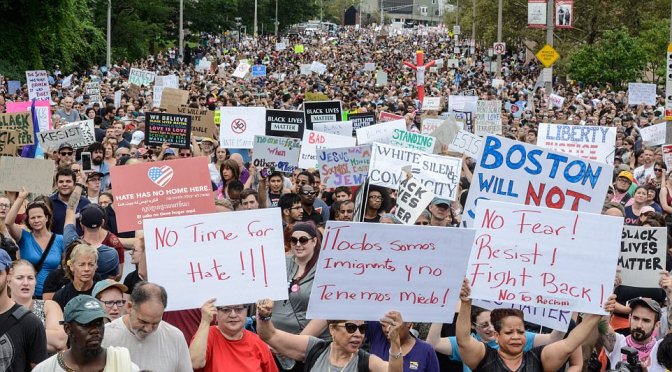


![Insurrection Starts at Home: Kevin Van Meter on Everyday Resistance [VIDEO]](https://antifascistnews.net/wp-content/uploads/2017/12/18815042_10158862347040249_5996743595254962902_o.jpg?w=615&h=372&crop=1)
![Mark Bray and Shane Burley Talk Antifascist History and Organizing [VIDEO]](https://antifascistnews.net/wp-content/uploads/2017/11/23456289_772803939571307_2660662324540890567_o.jpg?w=672&h=372&crop=1)


![The Sound of Resistance: Antifascist Interviews and Podcasts [AUDIO]](https://antifascistnews.net/wp-content/uploads/2017/11/podcast-header1.jpg?w=672&h=372&crop=1)
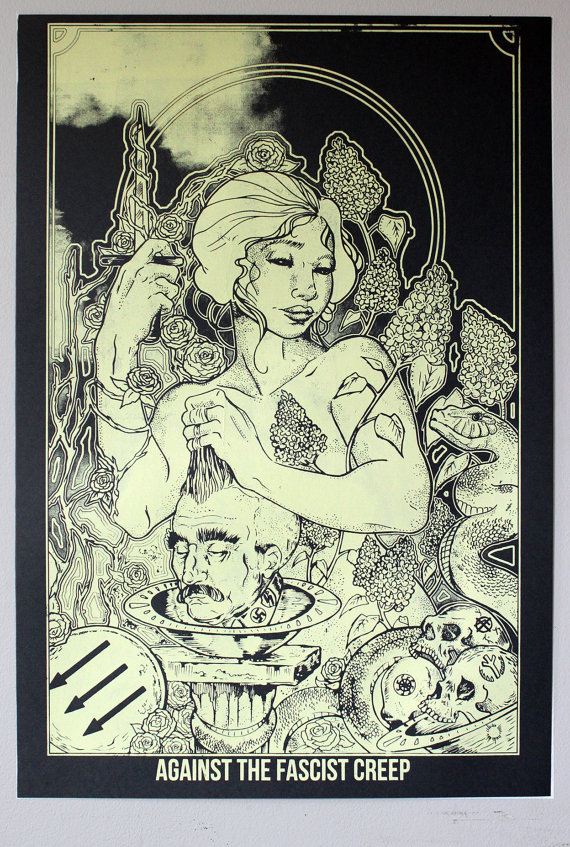



 Anti-Fascist News